




From your National President
Esteemed Members, Colleagues:
I am delighted to welcome our new Victorian Branch Co-Chairs – Jess Shepherd and Miriam (Shung Lai) Chiu. On behalf of the National Council, I would like to thank Jess and Miriam for stepping up to fill the role left by Karine Bachelier, who stepped down last month as Victorian Chair after many years of dedicated service to AUSIT and our profession.
I am writing to share some exciting updates following my recent visit to Tasmania. I am thrilled to tell you about the outcomes of this trip, along with some other important developments in our organisation.
My visit to Tasmania
Visiting Hobart on June 20–21 was certainly a highlight of my year. It was particularly special for me to return to this beautiful city where I completed my undergraduate degree at the University of Tasmania (UTAS) as AUSIT’s National President. The two days turned out to be incredibly productive, filled with precious professional development, networking and social opportunities.
I would like to acknowledge Echo Zhang, Martin Blackwell and the other members of the Tasmanian Branch, who put in many hours of volunteer work during business hours to make these events possible and give back to the local Tasmanian interpreting community.
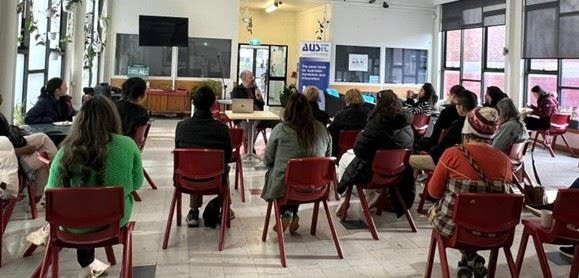
On the first day of my visit, I delivered three professional development sessions on court interpreting. The first two were held at the Tasmanian Civil and Administrative Tribunal (TASCAT), while the third was a hybrid event at UTAS focused on preparing for multi-day hearings. AUSIT is grateful to Richard Grueber and other TASCAT members for providing their space. This was a rare opportunity for legal and language professionals to come together and explore best practices for ensuring access to justice for parties with limited English proficiency.
On the second day, the Tasmanian Branch held the fourth event, which was generously sponsored by the City of Hobart. Colleagues said it was a fantastic opportunity to meet with local Tasmanian practitioners. I also took the opportunity to learn what AUSIT could do to further improve the working lives of Tasmanian practitioners.
Colleagues raised two main suggestions for the Tasmanian Branch. First, that English-speaking professionals should have better access to training on how to work with interpreters. Second, that more could be done to raise awareness among multicultural organisations and other entities serving culturally and linguistically diverse communities about the right to an interpreter. I encourage the Tasmanian Branch to explore how these suggestions might be practically implemented. The National Council will also do everything we can to assist.
The event was also a rare chance to discuss some recent developments in our profession, including:
Revision of the AUSIT Constitution
At the National AGM in November last year, members voted to allow the National Council to start planning for AUSIT to change its legal status to a Company Limited by Guarantee (CLG). As part of this process, AUSIT needs to adopt a revised constitution that is consistent with the Corporations Act’s requirements for a CLG.
The National Council took this opportunity to task Governology, a company that specialises in legal advice for professional associations, to conduct a complete review of our existing constitution. In addition to proposing new sections required by the Corporations Act, Governology’s findings drew attention to various provisions that don’t need to be mentioned in a constitution, but can be covered in by-laws or other policy documents.
Based on this advice, a revised constitution has been drafted and has now been signed off by the National Council, for members to vote on at this year’s AGM. It makes no substantive changes to AUSIT’s structure, but is shorter and simpler than the existing document.
The National Council is indebted to ACT Branch Chair Dave Deck for his tireless work on the Constitution. His tireless coordination of the Constitution revision project will ensure our organisation’s founding document continues to define AUSIT’s purpose and structure, and lay out the framework for how it is managed in the most accurate way possible.
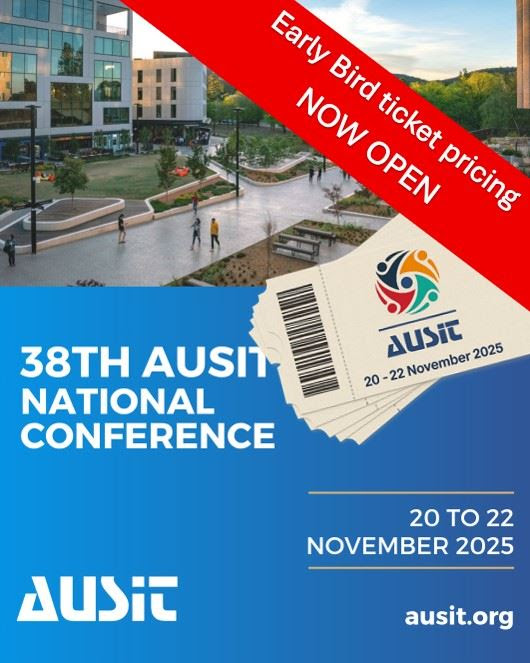
38th AUSIT National Conference

The Conference Organising Committee – chaired by the ACT Branch’s Chair, Dave Deck – is still receiving proposals for conference presentations, workshops and roundtables. They’re quite flexible on the sub-themes included, so don’t hesitate to contact them if you have an idea for a session, but you’re not sure if it will fit the theme.
And if you had an idea, but thought you wouldn’t have time to write the proposal, you’re in luck:
** Proposal submission has been extended to 14 July **
Meanwhile the venues for the event’s two networking/social events have been chosen, but the big news – if you missed it on Friday – is:
** ‘Early Bird’ discounted registration is now open! **
The discounts in most registration categories are substantial, and only available through July, so don’t forget to register soon.
And a shout out to any organisations thinking of sending representatives: we’re offering a further discount on group bookings of five or more – so get organised for November before the end of July … and save!!
Lastly (with regard to registration fees), to all our student members – your tickets are heavily discounted throughout the whole registration period, so don’t miss out on this networking opportunity that will springboard you into your future industry.
And on another conference-related note, we still have a range of sponsorship opportunities available – and it’s sponsorship that makes our conferences possible – so if you work for or run an LSP, government department or other stakeholder organisation, please do put the word around and/or consider sponsoring the 38th AUSIT National Conference.
AI Encroachments on our Profession
I would like to leave you with one last thought, on a topic that was discussed extensively during my recent visit to Tasmania – the ongoing impact of Artificial Intelligence (AI) tools on our profession. Large Language Models (LLMs) still have significant ‘hallucination’ rates, and this is unlikely to improve, even with better data. As more LLM output gets published online, it becomes increasingly difficult for models to find new data to train their algorithms. Computer scientists predict this will likely result in a phenomenon called ‘model collapse.’ Meanwhile, social scientists anticipate this impact will affect all knowledge worker sectors – not just translators and interpreters, but even those in occupations that have had centuries of professionalisation, such as medicine and law. Use of AI tools – and crucially, often unassisted by professionals with relevant expertise – continues to encroach on our profession around the world. Admittedly, in some places AI is augmenting human capabilities rather than replacing them entirely. For example, in the UK a company has developed ‘AI-enhanced’ interpreting and translation systems with funding from the taxpayer. These systems purport to combine AI technology with human interpreter services, offering on-demand personalised interpreting from trusted providers. There are, however, serious encroachments emerging in other countries. In Greece, AI has significantly disrupted the work of legal translators and interpreters – the government there recently announced plans to use AI for automatic translation of legal documents, interpreting of foreign witness testimonies, and voice-to-text recording of court proceedings. Meanwhile in the US, the court interpreting profession in the state of Wisconsin faces potential disruption from proposed legislation that would allow AI-assisted translation tools to replace or supplement human interpreters in civil and criminal proceedings. I raise these examples not to alarm colleagues, but as a reminder that the next few years are likely to be very challenging for the T&I profession. We are highly likely to face similar encroachments in Australia. Peak bodies such as AUSIT will continue to play an important role in advocating for sectors that are dominated by knowledge workers like translation and interpreting. The National Council – including the chairs of the various Branches – will ensure that translators and interpreters are at the table when decisions are being made that affect our careers and livelihoods. I encourage all AUSIT members who become aware of cases like these in Australia to report them to the National Council. We will do all we can to advocate for human expertise and standards across the T&I profession. |
With warmth and gratitude,
Carl Gene Fordham
AUSIT National President


Supporting Professional Standards Visit our website Check our Professional Development page for upcoming PD events Read our award-winning quarterly magazine In Touch Find past newsletters and magazine articles on our blog This communication direct from AUSIT is part of your membership benefits. |
Copyright © 2024 AUSIT, all rights reserved |