


SPECIAL FEATURE: AI IN T&I, PART 1

Nora Díaz, a Mexico-based Spanish–English interpreter and English>Spanish translator, explains how she has incorporated ChatGPT into her translation routine, and – and this may surprise some readers – into preparation for her interpreting assignments too, as well as getting it to help her with note-taking and organisational tasks.
ChatGPT has become … a powerful assistant that helps me work more efficiently and creatively.
When ChatGPT made its public debut, I was curious but cautious. Like many in our profession, I had questions:
Was it accurate? Could it really help with specialised content? Would it understand the nuances that are so central to our work as translators and interpreters? Fast forward to today, and ChatGPT has become a valuable part of my workflow – not a replacement for my skills, but a powerful assistant that helps me work more efficiently and creatively.
I’ve always embraced technology in my work, from CAT tools to speech recognition, and ChatGPT is just the latest addition to that evolving toolkit. But unlike other tools, this one feels more conversational, more exploratory. The way I use it varies depending on the task at hand, but it usually starts with a carefully crafted prompt – because as I’ve learned, the quality of the output depends heavily on the input.
Translation support that goes beyond glossaries
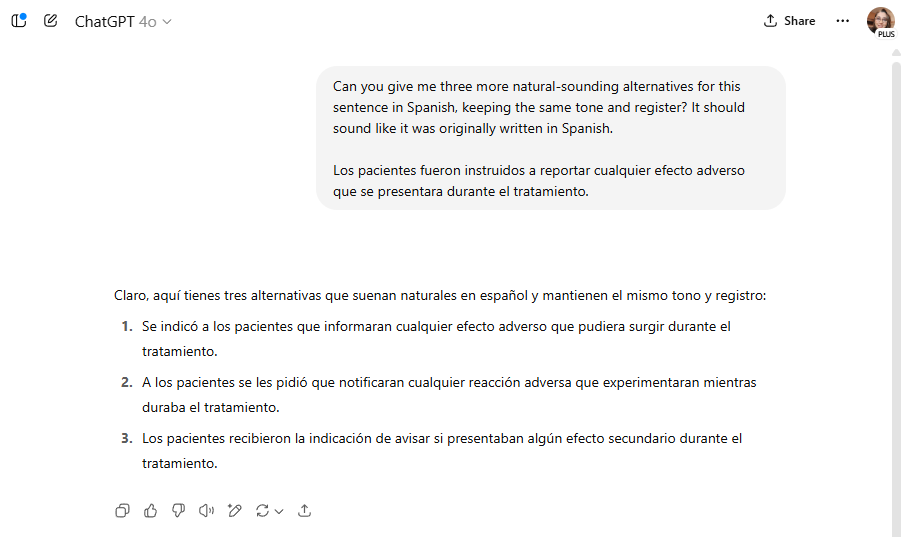
One of the ways ChatGPT supports my translation work is by helping me explore options. When I’m working on a particularly tricky segment – maybe something that sounds a little ‘off’ in Spanish, even though it’s technically correct – I’ll run a version of it by ChatGPT and ask for alternatives that preserve the tone, register and technical accuracy. Sometimes I’ll even ask it to rephrase something as if it had been originally written in Spanish. The goal isn’t to get a ready-to-use translation, but rather to spark ideas that lead to a more natural-sounding solution.
It’s also helpful when I’m reviewing a colleague’s work, or even machine translation output. I can ask ChatGPT to explain a term, compare usage, or even simulate how a non-native might interpret a particular phrase. This comes in handy when I’m wearing my reviewer or proofreader hat.
An example of a prompt to obtain alternative rephrasings:
Interpreting practice and preparation
As an interpreter, I use ChatGPT to prepare for assignments by simulating encounters or generating terminology lists on specific topics. For example, before a medical appointment to discuss a planned spinal surgery, I asked it to give me a list of key terms I should be familiar with – in both languages. It wasn’t perfect, but it gave me a solid starting point from which to refine my knowledge with my own research.
I’ve also used it to create mini roleplays for practice. If I know the setting and general theme of an upcoming assignment, I can have ChatGPT generate a sample dialogue which I then shadow, interpret or adapt as part of my warm-up routine. This is especially helpful when I need to work on a topic I’ve been interpreting less frequently, or need to switch gears between specialties.
It’s like having a second brain that doesn’t mind doing the tedious parts.
Notetaking and organisational help
ChatGPT is a great partner when I’m trying to organise ideas – whether I’m taking notes during a webinar, preparing a class or structuring a blog post. Sometimes I’ll paste a messy chunk of text and ask for a bulleted summary. Or I’ll dictate unstructured but related content and ask it to organise it into a structured email, paragraph or plan. Other times, I’ll ask it to help me format a table, timeline or checklist. It’s like having a second brain that doesn’t mind doing the tedious parts.
During online webinars or training sessions, I often take screenshots or copy chat comments. Later, I feed those to ChatGPT and ask for help organising them into actionable insights or group them by topic. This saves me the time needed to sort and retype – or, at the very least, copy and paste relevant information.
A bulleted summary of a piece of text:

What it doesn’t do
It’s important to acknowledge what ChatGPT doesn’t do well. I don’t trust it for up-to-date factual information or legal and medical precision without verification. I never use it to translate full documents, especially not sensitive ones. And while it can mimic tone, it still misses cultural context, humour and subtlety more often than not. I’ve learned to treat it as an intern, not a source of truth.
Privacy is another consideration. I always scrub sensitive information before pasting anything into a ChatGPT prompt, and I’m cautious about what I feed it from client projects. Furthermore, I use only the Plus version, and I make sure that my settings are such that the model won’t be trained with it.
A mindset shift
Using ChatGPT effectively requires a shift in mindset. Instead of seeing it as a machine that delivers answers, I approach it as a tool that helps me ask better questions. It encourages experimentation, reflection and iteration. It helps me break through blocks and look at language from a fresh perspective. And I’m not ashamed to admit that I feel it has made me a better translator. After all, I learn from every translation and interpreting project I work on, and those where ChatGPT helps me find a better turn of phrase are no exception.
For colleagues who are just getting started, my advice is this: Don’t be afraid of it. It’s just a tool, after all. Don’t wait for perfection. Start by playing with it. Give it a small task. See what happens. Then tweak your prompt. See what happens again. The more specific you are, the better the results. And remember, you’re still in charge.
Final thoughts
ChatGPT has changed the way I work, not by doing the work for me, but by helping me do it better. It’s the assistant I didn’t know I needed. It’s available 24/7, never tired, and always ready to brainstorm, rephrase or summarise. Like any tool it has its limits, but when used wisely it can be an incredible ally.
Whether you’re a translator, an interpreter or both, there may just be a place for AI in your workflow if you approach it with curiosity, caution, and a willingness to experiment. For me, it’s not about replacing human expertise, but about expanding what’s possible with it.
English>Spanish translator and conference interpreter Nora Díaz enjoys using technology and finding ways to increase productivity, and combines these with her love of teaching by sharing what she has learned – through a blog, articles, webinars and workshops. Nora also chairs the Professional Development Committee f the American Translators Association (ATA) and co-hosts the AI in Translation Summit and the AI in Interpreting Summit. She has co-authored a book: Version 15 of The Translator’s Tool Box; was listed as one of the Top 30 Women in the Language Industry by Multilingual Magazine in 2023; and was awarded the ATA’s Innovation Award in 2024.