


RECENT RESEARCH
Researchers: Chelsea Larkman, Dr Lucette Lanyon and Professor Miranda Rose
Institution: Centre of Research Excellence in Aphasia Recovery and Rehabilitation, La Trobe University
Speech pathologists have identified a number of challenges to delivering aphasia therapy when they do not share a language with their clients.
However, little has been heard from interpreters about what it is like for them to collaborate with speech pathologists for aphasia therapy. This is despite interpreting for speech pathologists and people with aphasia being recognised as a complex area of practice.
Researchers at the Centre of Research Excellence in Aphasia Recovery and Rehabilitation at La Trobe University conducted a study to explore interpreters’ experiences of working with speech pathologists to support the provision of aphasia therapy (Larkman et al., 2024). Eight NAATI-certified interpreters were recruited and participated in semi-structured interviews. Interpretative phenomenological analysis (IPA) was utilised to analyse the data.
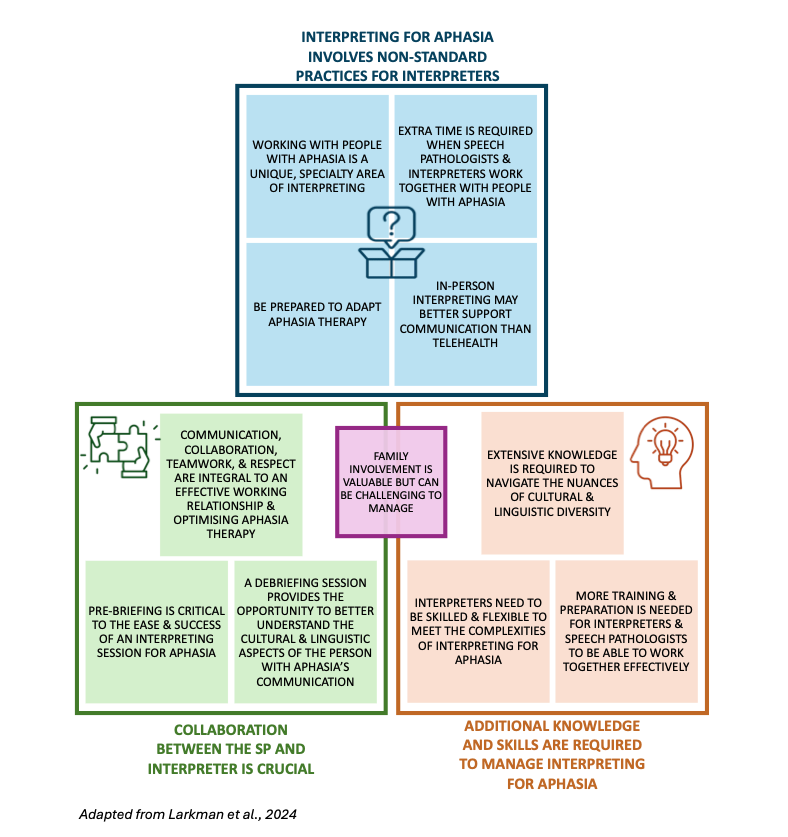
Data analysis identified eleven themes that were grouped into three over-arching categories:
- interpreting for aphasia involves non-standard practices for interpreters;
- collaboration between the speech pathologist and interpreter is crucial for understanding critical aspects of aphasia therapy and interpreting; and
- additional knowledge and skills are required to manage interpreting for aphasia.
The figure below further outlines the themes within each category:
The results reinforced that interpreting for aphasia is an area of specialised practice (a finding that has been previously emphasised in the literature regarding interpreter-mediated aphasia assessment). The study concluded that both speech pathologists and interpreters need more training on how to effectively collaborate. It was recommended that training should cover each profession’s roles and the BID (briefing, interaction, debriefing) process as it relates to aphasia therapy. Additionally, linguistic diversity and how it may affect aphasia therapy should be addressed in education programs, along with ways to navigate discussions about cultural differences.
The findings also highlighted the need for recognition of the increased time requirements of providing aphasia therapy to culturally and linguistically diverse clients. It was suggested that in order for health services to truly provide culturally responsive and equitable aphasia services, broader systemic change that recognises the importance of increased training, resources and time is needed.
The research team’s paper, ‘“It’s so complicated”: A qualitative study of interpreters’ experiences working with speech pathologists to support the provision of aphasia rehabilitation,’ published in Disability and Rehabilitation, can be purchased here.
If you would like any further information about this study, please contact researcher Chelsea Larkman.