
For Students, Educators & Researchers
Thinking of studying translation and/or interpreting?
Why become a Student Member of AUSIT?
AUSIT Language Divisions
AUSIT Mentoring Program
AUSIT Student Excellence Awards (annual)
AUSIT Student Translation Competition (annual)
Resources and Grants for Researchers
AUSIT’s Educational Affiliates
Videos & Podcasts
For Practitioners
The Benefits of being a Member of AUSIT
Join AUSIT: Application Form
Guidelines and Resources for Practitioners
The AUSIT Code of Ethics
Professional Development
AUSIT Mentoring Program
Webinars
Free NAATI-Sponsored Webinars (conditions apply)
AUSIT Events
In Touch magazine
AUSIT Language Divisions
Blogs (including past President’s Newsletters)
Videos & Podcasts
AUSIT Awards and Fellowships
The Sydney Declaration (AUSIT National Conference Statement 2023)
Interpreter Feedback Form and Reports: experiences in courts and tribunals
Duration:
2 Hrs
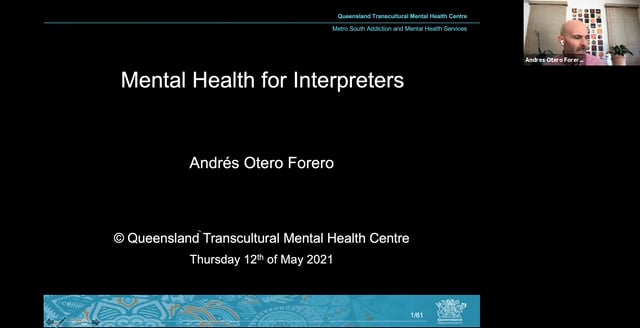
Presenter -
Andrés Otero Forero
Free (Non-Member) | Free (Member) | Free (Non-member Institution) | Free (Affiliate)
The aim of this webinar is to provide interpreters with background knowledge of mental illness, psychiatric interviewing and assessment, outline the common interpreting challenges, offer some strategies for interpreting in a range of psychiatric consultations and discuss positive coping strategies.
Interpreting in mental health settings is complex and interpreters face multiple challenges. Mental health and allied mental health professionals rely primarily on verbal and non-verbal communication for assessment, diagnosis, and treatment.
For a successful therapeutic relationship, interpreters require contextual knowledge and an understanding of the role communication plays in the different types of encounters e.g. psychiatric assessment, cognitive assessment, therapy, or family meetings). For example, to make a correct diagnosis, it is crucial to understand the client’s cultural references as well as how he/she communicates (i.e. tone, volume and rate). The challenge for the interpreter is to accurately represent these in order to enable the clinician to make the most appropriate clinical decision.
A common culture or history between client and interpreter may increase the interpreter’s credibility, as well as their ability to fulfil their role. It is important for interpreters to develop positive coping strategies.
Presenter – Andrés Otero Forero
This workshop is facilitated by Colombian-born psychologist Andrés Otero Forero.
Andrés has extensive experience in education. He was a guest lecturer at different academic institutions before coming to Australia in 2003. Since then, Andrés has worked in the multicultural sector. He currently works in the Queensland Transcultural Mental Health Centre as the Clinical Educator.
Duration 1 hr 59m
Other webinars you might be interested in
for court interpreters to report incidents or issues that occur in court interpreting assignments.
Purpose and function of this information submission form.
This form enables you to report issues or problems that you encounter in the course of court interpreting assignments. These issues and problems will be collected by AUSIT to report to the JCCD (the Judicial Council on Cultural Diversity) to monitor the implementation of the Recommended National Standards. The reporting of these issues and problems enables AUSIT to work with the JCCD to suggest steps to address these issues and to avoid the repetition of these problems in the future.
"*" indicates required fields
Select your desired option below to share a direct link to this page