



Chris Poole – AUSIT Past President (2005–06) and Director of Chris Poole Translations – has interpreted at, or sourced an interpreter for, the Melbourne Writers Festival for the last three years. We asked Chris to tell us about the unique challenges and rewards of this specialised literary interpreting work.
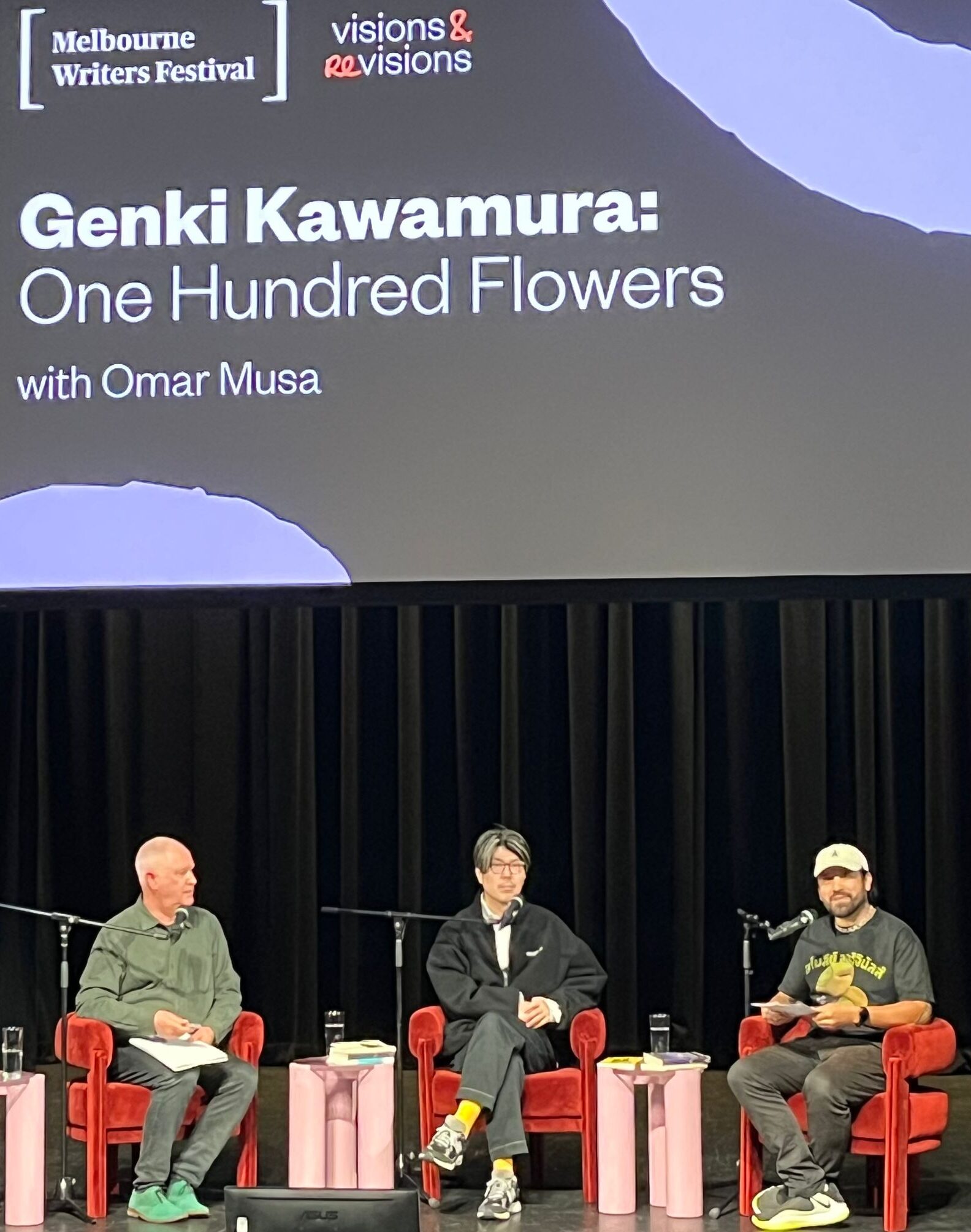
Image: Chris (left) onstage at MWF 2026, interpreting a discussion between Japanese author Genki Kawamura (centre) and Malaysian-Australian author, artist, rapper and poet Omar Musa
1) What qualities/skills do you look for when choosing interpreters to work at the MWF?
An important quality is the emotional vibe you bring to the stage. It’s essential that you’re relaxed and obviously in love with your work so that you can reproduce all the pragmatic features of the speech. That really helps set the tone of the event. You don’t want to come across as stiff or nervous, or just robotically neutral. That creates a very unnatural feel. To achieve this, it’s important that the interpreter works for me full time – I wouldn’t try to do this with a casual. A person who already has very good skills and an even better attitude needs to work for me full time for a couple of years to understand our system, because we don’t operate like other T&I agencies. What it means to work for me can be found here. I’ve only had a couple of staff in the past who could have done this kind of work. Emily Fukuda Molinaro has worked with me for four and a half years, including at the last two Melbourne Writers Festivals.
2) What are some of the unique challenges of interpreting for a literary festival?
Making money! Taking all our hours into consideration, I think we (the company) only made about $25 per hour on this year’s festival. The only way we get to do these things is by subsidising them through our other work, which averages more like $140 per hour gross profit. Emily is on a fixed salary. Unusual things do come up when you’re part of an event like this. This year we had extensive correspondence with the moderators/interviewers beforehand in which we raised problems with existing translations, and they were very grateful for this. Plus we both had the experience on stage of the moderator asking us to comment on the translation, which raises issues regarding the boundaries of the interpreter’s role.
3) Does the interpreter need to be familiar with the work of an author they will interpret for?
Well, that’s a good question. We tend to assume that we need to be, because if something came up and we were unfamiliar with its context, that would limit our ability to construct sentences. This would perhaps be apparent, and therefore make for poor quality interpreting. On the other hand, the breadth of topics that come up in an interview is sometimes so great that the actual content of the book is relatively trivial. But just in case, we read their main recent works – in both languages, of course. For this year’s festival Emily and I each interpreted for a different Japanese author and just in case, we read their main recent works and watched a movie – in both languages – in the lead up. Importantly, both of the authors we worked with this year have been interviewed extensively in and outside of Japan, so there were plenty of Youtube videos that we could study to see the sorts of things they discuss, acclimatise to their idiolects, and find out how other interpreters have translated their ideas. All these preparatory hours are what make it hard to make much money.