




ASSISTIVE TECHNOLOGY
In his April/May President’s Newsletter, AUSIT National President Carl Gene Fordham gave feedback on a campaign initiated by the AUSIT Advocacy Committee against the increasing use of telephone interpreting in courts and tribunals. Carl pointed out that interpreters working on site with non-English-speaking litigants in Australia can use two distinct types of equipment to aid their work: hearing loop receivers and simultaneous interpreting (SI) equipment.

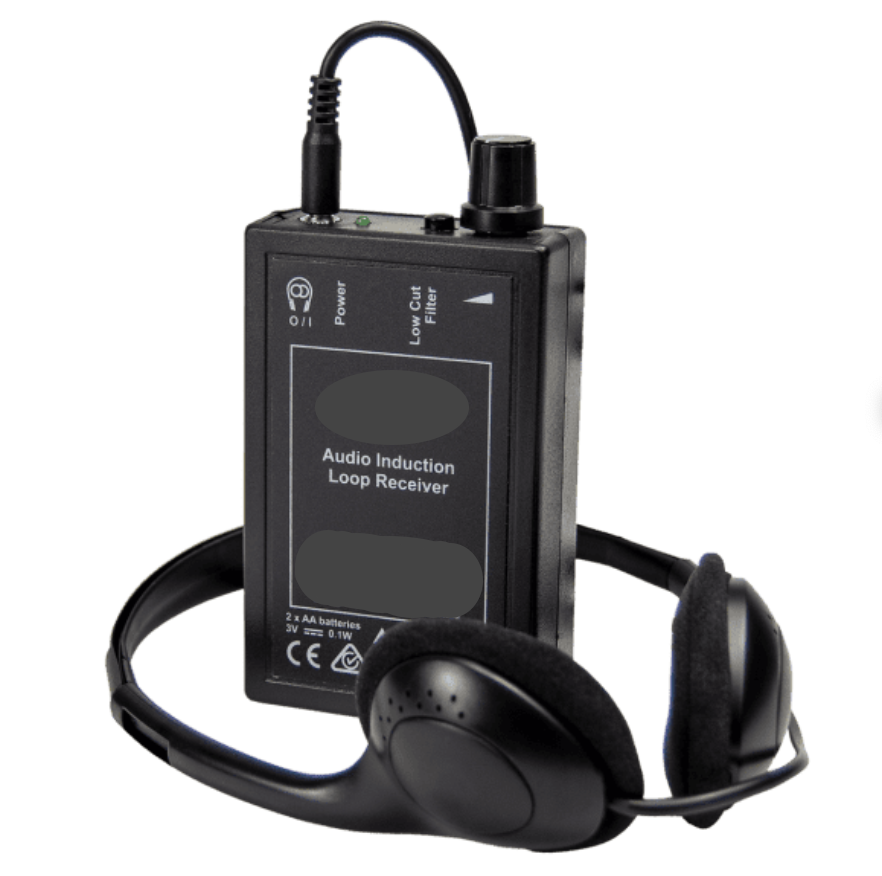
A hearing (or induction) loop receiver is a small handheld or wearable device that picks up the electromagnetic signal broadcast by a courtroom’s hearing loop system, which is primarily designed to assist people with hearing impairments.
When used by an interpreter, it allows them to clearly receive amplified audio of courtroom proceedings, particularly the judge, counsel and witnesses speaking into their microphones. This reduces interference from background noise and improves audibility.
The interpreter listens through an earpiece or headphones that they have connected to the receiver, then renders the spoken content into the target language for the litigant, typically in a soft voice (known as whispered interpreting or chuchotage).
The AUSIT Advocacy Committee and Communications Officer recently worked together to produce an information sheet titled Hearing Loop Receivers for use in Court. You can find a link to this info sheet, along with other useful resources, on the AUSIT website’s Guidelines and Resources for Practitioners page.
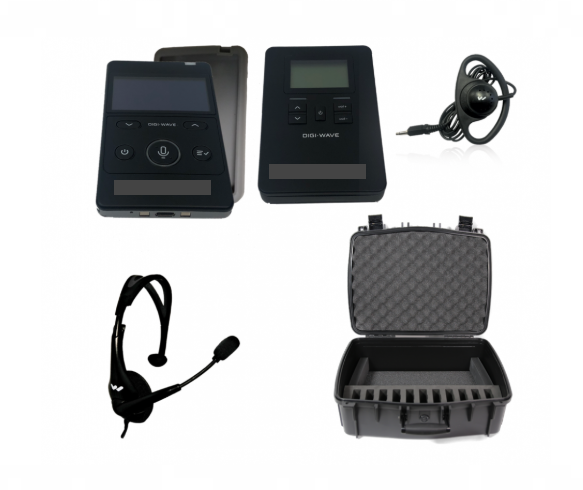
Simultaneous interpreting (SI) equipment, by contrast, is a dedicated system comprising a transmitter, an interpreter microphone, and wireless receiver units with earphones.
The interpreter delivers the interpretation in real time into the microphone as proceedings unfold, and the transmission is broadcast wirelessly to the non-English-speaker’s receiver unit, allowing them to hear the interpretation in their language through their own earpiece without it disrupting the courtroom.
In n criminal trials, the use of SI equipment is particularly useful in setting up a physical distance between the interpreter and the non-English-speaking defendant. This can prevent risks to physical and psychosocial safety. The illustration in an ABC news article covering a trial in which a man was jailed for fatally amputating another man’s foot makes it clear that the Bislama interpreter – who interpreted emotionally charged messages, including a tearful apology at the end of the trial – had to sit directly next to the defendant in the dock. I cannot help but comment that the use of SI equipment in cases like this would allow the interpreter to remain more physiologically detached from what I imagine would have been a highly distressing situation.
In Queensland, simultaneous interpreting (SI) equipment is readily available at state courts in Brisbane, and can be booked for use at state courts outside the capital. I am not aware of it being used in the federal courts. In New South Wales, SI equipment can be borrowed from Multicultural NSW. I am not aware of SI equipment being available outside QLD and NSW. Some colleagues have purchased their own SI equipment to use on the job.
Members are encouraged to write to courts in their local jurisdiction to request access to SI equipment if it is not available to them. I also encourage you to pass on the message to colleagues about this equipment, as many still do not know that it exists and how useful it is. It is especially useful in mitigating interpreter fatigue – and also strain in both the throat and the lower back – from carrying out sustained chuchotage while sitting close to the non-English-speaking defendant.
Carl Gene Fordham is a NAATI-certified translator (Chinese>English) and interpreter (Mandarin–English) based in Melbourne. He currently serves as AUSIT’s National President.