
For Students, Educators & Researchers
Thinking of studying translation and/or interpreting?
Why become a Student Member of AUSIT?
AUSIT Language Divisions
AUSIT Mentoring Program
AUSIT Student Excellence Awards (annual)
AUSIT Student Translation Competition (annual)
Resources and Grants for Researchers
AUSIT’s Educational Affiliates
Videos & Podcasts
For Practitioners
The Benefits of being a Member of AUSIT
Join AUSIT: Application Form
Guidelines and Resources for Practitioners
The AUSIT Code of Ethics
Professional Development
AUSIT Mentoring Program
Webinars
Free NAATI-Sponsored Webinars (conditions apply)
AUSIT Events
In Touch magazine
AUSIT Language Divisions
Blogs (including past President’s Newsletters)
Videos & Podcasts
AUSIT Awards and Fellowships
The Sydney Declaration (AUSIT National Conference Statement 2023)
Interpreter Feedback Form and Reports: experiences in courts and tribunals
Duration:
2h 22m
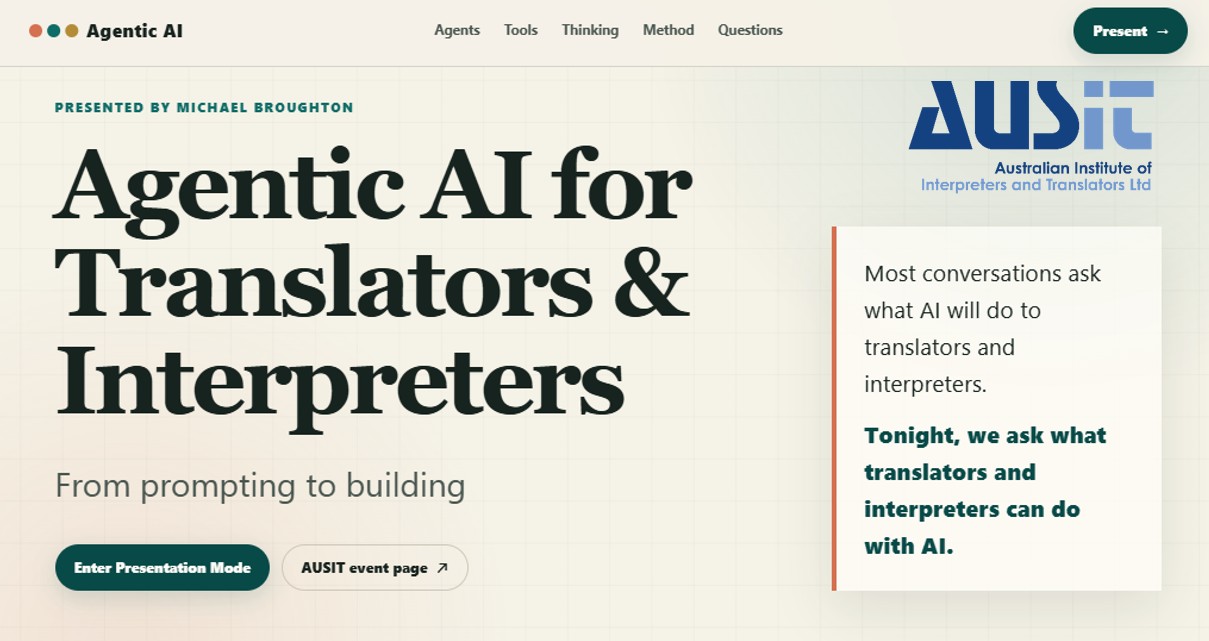
Presenter -
Michael Broughton
$105.00 (Non-Member) | $35.00 (Member) | $300.00 (Non-member Institution) | $150.00 (Affiliate)
What if it is actually possible to make our own tools?
If you have been reading AI-related news you will have heard of things called AI agents. These are large language models that can make you feel like another person is working on your computer. They can browse the web, build applications, make files and do all sorts of things that, to some, might feel almost a little like magic (like black magic when they delete a company’s entire production database!). They can also feel out of reach—a distant technology to be used by AI initiates and coders—inaccessible to the common man.
And yet they are not. Agentic AI is very accessible and can be easily used by people without any tech or coding knowledge. If you use ChatGPT, even the free version, you have some access to Codex, OpenAI’s agentic coding model. If you have a subscription to Claude, then you have access to Claude Cowork and Claude Code. These tools are extremely powerful and can be used to help translators and interpreters be more productive. They also carry novel risks that we must take care to manage and avoid.
In this webinar we will:
Our Presenter – Michael Broughton
Michael Broughton was once a teacher of translation at the University of Melbourne and is now back there as a student completing his PhD. Outside of studying, Michael works as a translator of Chinese through his business mbChinese, and as an interpreter of Gold Rush Victoria at Sovereign Hill.
Michael is currently Vice President for Professional Development and Events at AUSIT and has an active interest in how translators and interpreters can navigate a future of meaningful work in a world dominated by AI technologies.
Other webinars you might be interested in
for court interpreters to report incidents or issues that occur in court interpreting assignments.
Purpose and function of this information submission form.
This form enables you to report issues or problems that you encounter in the course of court interpreting assignments. These issues and problems will be collected by AUSIT to report to the JCCD (the Judicial Council on Cultural Diversity) to monitor the implementation of the Recommended National Standards. The reporting of these issues and problems enables AUSIT to work with the JCCD to suggest steps to address these issues and to avoid the repetition of these problems in the future.
"*" indicates required fields
Select your desired option below to share a direct link to this page