


SPECIAL FEATURE: AI IN T&I / BOOK REVIEW
edited by Tanya Escudero, Päivi Kuusi & Sabine Braun
reviewed by Dr Ron Witton
In some ways this is a daunting book. Its 10 well-researched chapters are linked via copious footnotes to numerous studies. These have informed the book’s many authors, who examine – often in minute detail – a wide variety of situations that confront interpreters and translators in a multitude of countries.
However, as T&I practitioners we are always on the lookout for studies that examine the daily dilemmas we face in solving issues and improving our practice, and this book can be helpful in this regard.
Drawing on studies from countries as diverse as the Netherlands, Australia, Estonia, Denmark, Finland, Austria and Norway, it leads us to consider our daily practice here in Australia. It may also make us appreciate having in NAATI a national accreditation body, and in AUSIT a professional association that represents our interests. While not specifically addressed in the book, one cannot but surmise that in this regard Australia is well placed to help the world develop best practice in T&I.
This is reflected in Chapter 1, ‘Best-practice translation approaches for multilingual public service communications in Australia,’ by AUSIT’s Immediate Past President Erika González, National Secretary Miranda Lai and National PD Coordinator Epperly Zhang. González, Lai and Zhang use the COVID-19 pandemic to illustrate the demands and opportunities that arose in Australia from this life-changing event.
Interestingly, the pandemic also features in Chapter 4 ‘Translation awareness in communicating COVID-19 information to speakers of non-official languages in Finland and Estonia,’ providing Australian readers with an immediate comparative context to their own recent life experience.
Many of the authors acknowledge that professionals who work in areas such as health, where the population comes from linguistically diverse backgrounds, are constantly switching between the written and spoken word, and hence the term ‘translation’ is regularly used to stand for both interpreting and translation.
The brackets around ‘Un’ in the book’s title and throughout its pages serves to remind readers of the profound effects of being aware, or unaware, of good and poor T&I practice.
The role of T&I is examined across widely diverse areas, including the law, business, research, audiovisual contexts and publishing; and readers are alerted to the fact that bi- and multilingual professionals switch constantly between their languages, and are often reluctant to call on the services of accredited T&I practitioners. Moreover, several chapters address the implications of machine translation’s seduction of monolingual professionals into thinking they can bypass professional T&I services altogether.
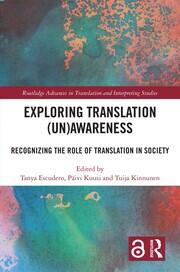
Cover reproduced courtesy of Taylor & Francis Group
The diversity of research cited in this book’s chapters is an inspiration to those who wish to explore our field further. It is available in both hard and e-copy, and one would hope that academic libraries will have it available to those in our profession who are contemplating postgraduate research.

Dr Ron Witton is an Indonesian and Malay translator and an Indonesian interpreter. He gained his BA and MA in Indonesian and Malayan Studies from the University of Sydney and his PhD from Cornell University, USA. Ron is a foundation member of AUSIT, and has also chaired NAATI’s Indonesian and Malaysian Language Examining Committee (1992–2007).