


The AUSIT Excellence Awards are awarded biennially, to recognise initiatives and activities by individuals and organisations operating in all sectors of the translating and interpreting industry. They encourage best practice, professionalism, dedication to quality, innovation and outstanding contributions. In 2025, Excellence Awards were given to celebrate three individuals, in the following categories:
Outstanding Contribution to the Interpreting Field
Dr Kirri Dangerfield
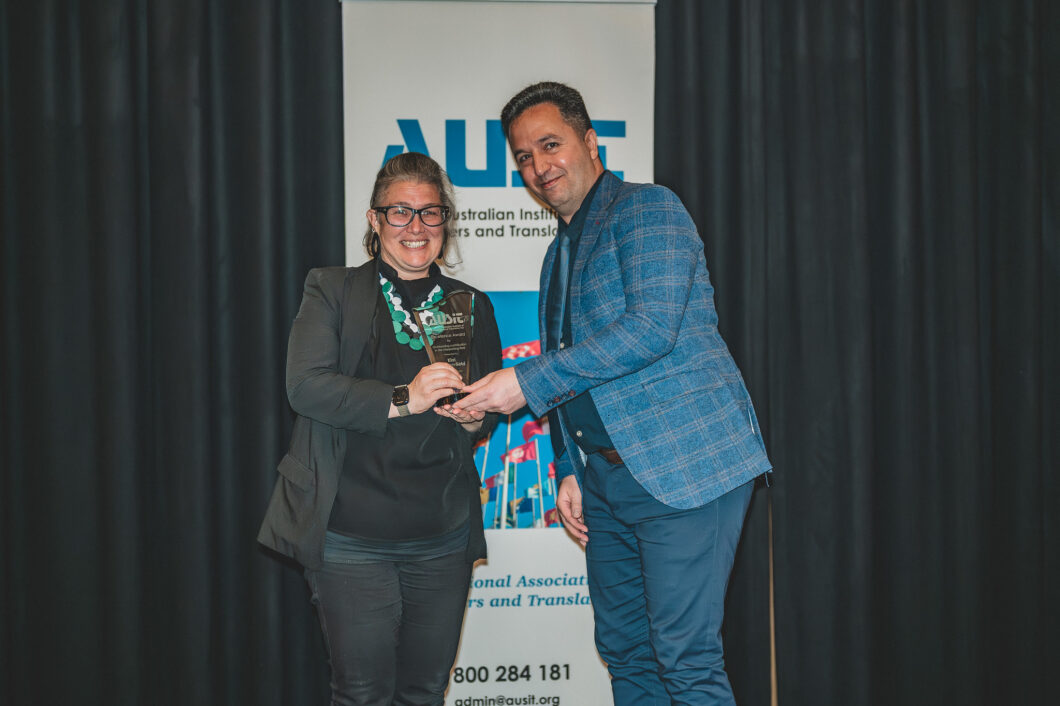
Dr Kirri Dangerfield has made an outstanding contribution to Auslan–English interpreting through over two decades of professional practice, research, and leadership. Her PhD advanced understanding of team interpreting and practitioner support, creating a framework now influencing training and reflective practice across the field. She has published and presented widely, sharing her insights nationally and internationally. Kirri has also strengthened interpreter education, leading the redevelopment of Monash University’s mental health interpreting course, and has served in key professional roles with ASLIA and AUSIT. Her work has had lasting impact on both interpreters and the communities they serve.
Outstanding Contribution to Capacity Building
Liying (Lynn) Geng

Lynn has made outstanding contributions to the Translation and Interpreting field through her extensive work in promoting interpreter awareness and professional standards. She has presented at numerous national conferences and delivered training sessions to judicial officers, lawyers, and T&I professionals across Australia. Lynn’s work has been instrumental in highlighting the challenges interpreters face and advocating for fairer, more informed practices within the justice system. Her efforts have strengthened collaboration between interpreters and legal professionals, improving the quality of communication and access to justice for linguistically diverse communities nationwide.
Lynn teaches legal interpreting at UQ, mentors interpreters, and delivers training on how to work effectively with interpreters in legal settings, promoting the application of the Recommended National Standards for Working with Interpreters in Courts and Tribunals.
Outstanding Contribution in Languages of Limited Diffusion (LLDs)
Olena Radievska

Since the outbreak of the full-scale war against Ukraine in 2022, Olena has become a leading figure in Ukrainian-English language services in Australia, supporting the refugee community and national and international institutions. Her interpreting has been entrusted by the ABC, AFP, Victorian Institute of Forensic Medicine, Foundation House, and global media and humanitarian organisations. Her translation work has preserved the voices of Ukrainian defenders, poets, and victims of war. In 2025, she co-developed and began teaching the first Ukrainian T&I stream at RMIT University, shaping the next generation of Ukrainian interpreters and translators to amplify Ukraine’s voice in the world.
Olena’s contribution exemplifies commitment and leadership of the Tier C/D category. She has responded to urgent community and institutional needs with professionalism, compassion, and innovation, contributing to the professionalisation and visibility of Ukrainian interpreting and translating in Australia. These contributions go beyond individual assignments and establish lasting capacity for the field of Ukrainian T&I, creating pathways for aspiring practitioners and ensuring that Ukrainian voices are heard, understood, and represented with integrity across languages and cultures.