




Interviewed by Hania Geras
INTERVIEW SERIES
When AUSIT was formed, Italian interpreter and educator Luciano Ginori was elected its first president. Hania Geras, a current member of the AUSIT NSW Branch Committee, recently met up with Luciano to ask him about his involvement in T&I and those early days of AUSIT.

‘… you speak English pretty well for a foreigner … Why don’t you think about it?’
Hania: Luciano, thanks for allowing me to reach out to you. I feel quite honoured to be conducting this interview with AUSIT’s very first president! My first question is: where does your interest in languages come from?
Luciano: Well, my interest in languages comes from the fact that I used to be a teacher. In fact, when I came to Australia, which was in April 1967, I had some contacts with the Italian Educational Officer at the Italian Consulate, and I was asked to teach Italian in some Sydney primary schools, following which I became involved with the Good Neighbour Council.*
After that I was involved with the Ethnic Communities Council, and became its secretary, and I did quite a lot of work in the community – to the extent that I got a medal from the Queen [Luciano chuckles], would you believe? – for community services during my stay at the Ethnic Communities Council.
Now, in 1969, I got married, and shortly after I got a job with a small private company called Vanguard Investment Services. And one day, I was at lunch with my boss, together with one of his friends who happened to be a lawyer. That solicitor told me that they were short of interpreters in the courts and he said, ‘Well, you speak English pretty well for a foreigner’ [Luciano chuckles again], and he said, ‘Why don’t you think about it?’ So I spoke with my boss, and he said, ‘Okay, I’m happy for you to do that, so long as, of course, if you do some work for the interpreting, well, I won’t pay you for that, because you’ll get paid by them.’ Anyway, to cut a long story short, I went to do a test with the – then – the official court interpreting organisation, which was on the floor above the police station attached to the court in Liverpool Street …
Hania: In Liverpool Street in the city?
Luciano: Yeah, which was not far from where my office used to be. And the head of the interpreting service, a Polish fellow called Brodsky … I can’t remember his first name … Anyway, he claimed he spoke 14 languages, and he did actually speak very good Italian, and he gave me a test and obviously I passed it, so I was enrolled in the official interpreters panel for the courts, and I did quite a lot of work during that period, during the 1970s, to 1977.
In 1977, the Premier’s Department established the Community Interpreter Information Service as part of the newly formed Ethnic Affairs Commission of New South Wales.
So, I applied, and I got the job as interpreter in charge of the Hurstville Branch Office. I was there for a while, and then I was transferred to the Head Office in Phillip Street, in the city, and I was promoted to Deputy Coordinator of the Service. My main responsibility was the recruitment and training of interpreters and translators.
Hania: In all languages? Not just Italian, but all languages?
Luciano: Yes, yes, yes … that was just recruiting people to become members of the Community Interpreter Information Service – the CIIS.
Hania: Of the panel? Or the service?
Luciano: Yeah, and we – and the new service actually incorporated and took over the old official court interpreters panel that I was originally a member of. In fact, some of the people – Mrs. Rosso and Miss Kiisler actually – came to work for us at the newly established Community Interpreter and Information Service of the newly established Ethnic Affairs Commission of NSW, which was linked to the Premier’s Department. Then Mr Brodsky retired.
So, I worked for the Commission, and in 1987, a conference was being convened in Canberra, for the formation of AUSIT. But in the meantime, over the years, I was with the Community Interpreter Information Service, and I became very active with the profession. In 1987, I was also asked to teach at the newly established University of Western Sydney in the interpreter section, because they were establishing new courses for interpreters. At the same time, having been given permission to go part-time teaching at the University of Western Sydney, I was also given permission to teach part time in the newly established courses for interpreters at the Petersham TAFE. So, I taught at the University of Western Sydney until December 2010, and at Petersham TAFE until December 2011.
… the first AUSIT National Council and I believed that it was important to be (and be seen as) representing the profession as a whole.
Hania: How did you get involved with AUSIT?
Luciano: Well, as I mentioned before, during my period of working as a court interpreter I became very involved with the profession, and eventually, when NAATI convened the conference in Canberra for the establishment of the first national association of interpreters and translators, I was sent to participate in a group of people who were there to discuss the formation of AUSIT. At that conference, an interim committee for the formation of AUSIT was established and an election was held. I was elected president of the interim committee.
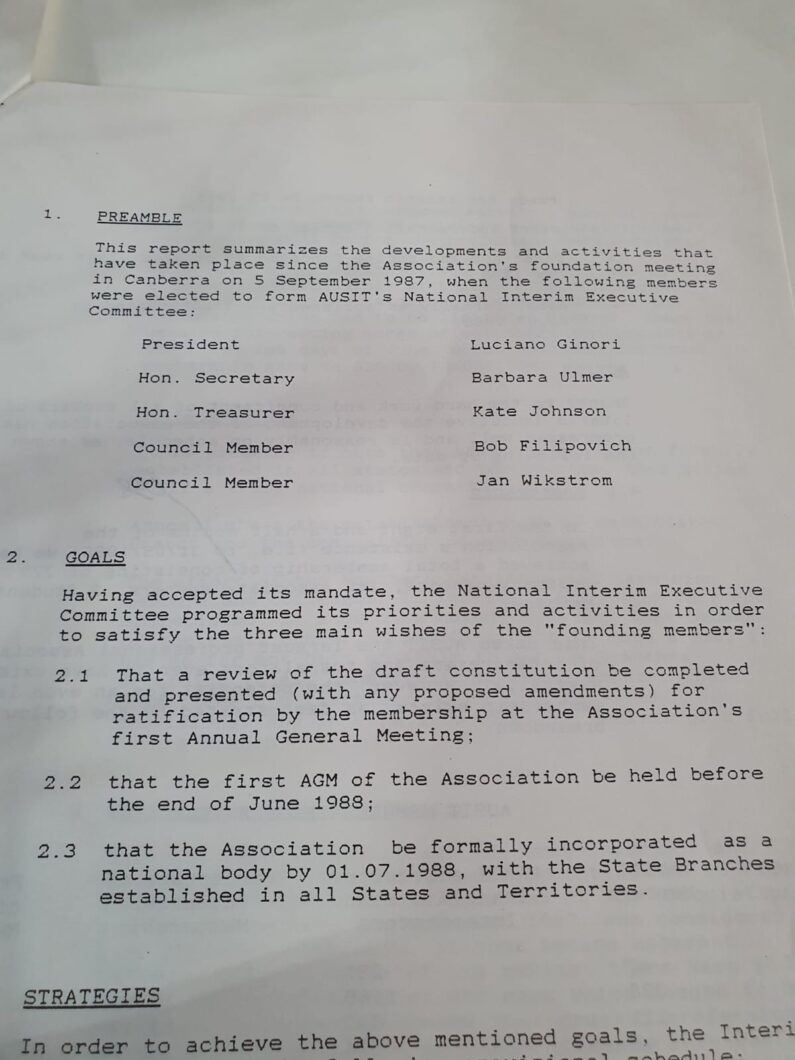
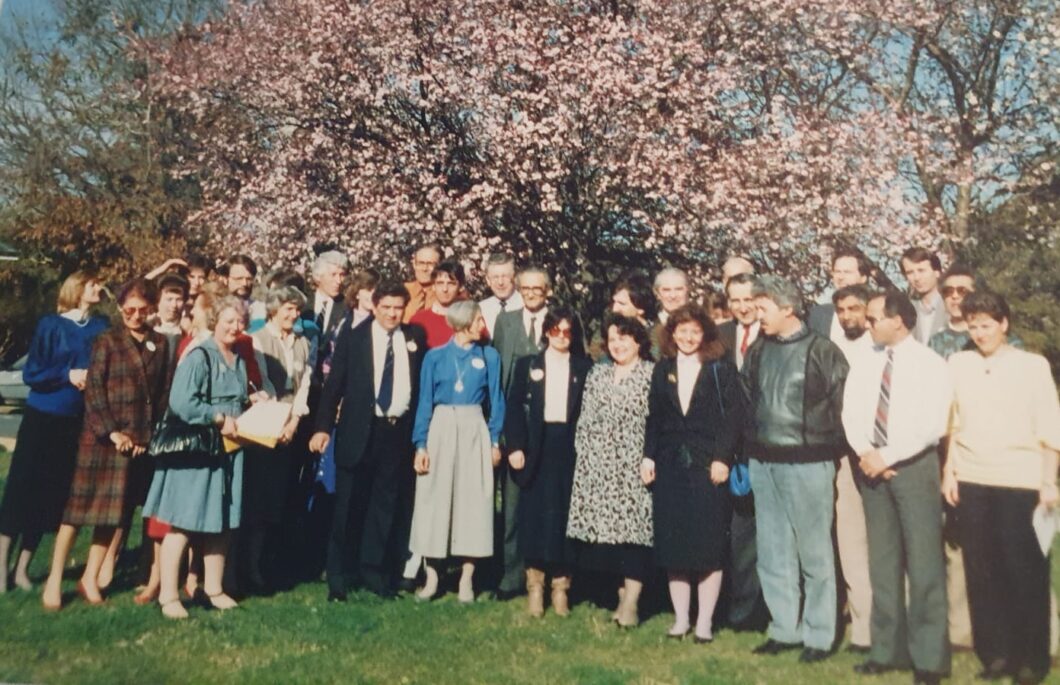
Above left: Luciano’s copy of the minutes of the meeting in Canberra in 1987; and right: attendees of the NAATI conference in Canberra at which the interim committee was established, 5 September 1987. From left to right: Jane Munro (NSW), Iro Melbye (NT), Sherrill Bell (NAATI), [darkhaired female with hand raised], Valerie Taylor-Bouladon (ACT), Kate Johnson (NSW), Heinrich Stefanik (ACT), Lorna Kempner (VIC), Susana Hovell (NSW), Peter Martin (NAATI), Anne Looker (NAATI), [male in dark suit], Paul Sinclair (NAATI), Stuart Campbell (NSW), Jill Blewett (SA/NAATI), Peter Davidson (QLD), Luigi Mastellone (NSW), [female in brown sunglasses], Adriana Daniel (VIC), Paul Hellander (SA), Ted Kempner (VIC), Mary Gurgone (WA), [female obscured, male obscured, possibly Jan Wikstrom (NSW)], Anthony Restuccia (NAATI), Luciano Ginori (NSW), Arman Turkay (later Armand von Stein) (QLD), Mahendra Pathik (TAS), Luigi Timpano (SA), Bob Filipovich (VIC), Antonio Flores (VIC), Barbara Ulmer (NSW).
Luciano: Then in the following year, 1988, with the help of the interim committee established in Canberra, we held the first meeting of that committee at the Opera House in Sydney. It was then that AUSIT was officially established, and I and some of the other members of the interim committee, including Barbara Ulmer as secretary and Kate Johnson as treasurer, were confirmed as full members of the newly established AUSIT, and I was elected as its first president.
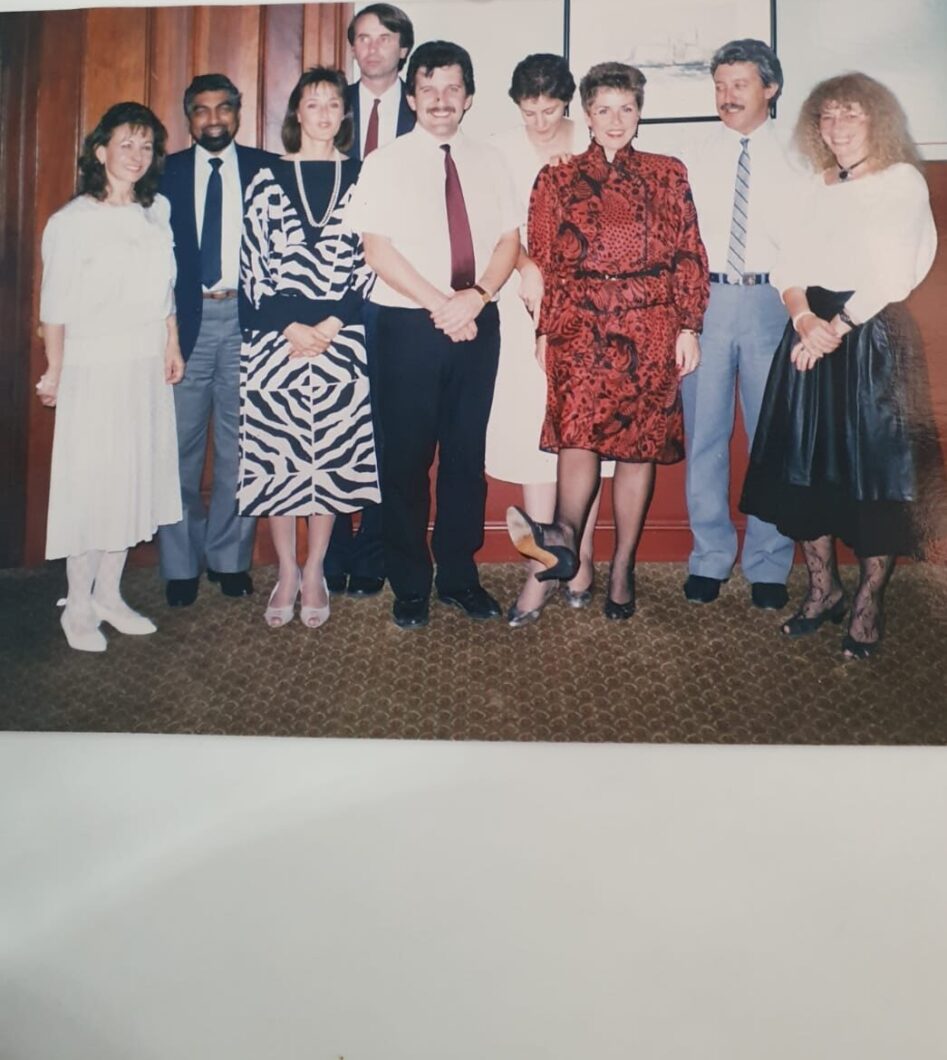
Above: attendees of the first AUSIT National AGM, Sydney Opera House, 1988, left to right: Mary Gurgone (WA delegate), Mahendra Pathik (Tasmanian delegate), [unidentified], Bob Filipovich (elected National Vice President), Paul Hellander (SA delegate), [unidentified], Barbara Ulmer (elected General Secretary), Luciano Ginori (elected National President), Luciana Nicholls (NT delegate)
Hania: What happened before 1987?
Luciano: Okay. In 1983, while I was still working with the Ethnic Affairs Commission, I did a NAATI test for interpreting and translation, and I became accredited at a professional level in both for the Italian and English languages, following which – particularly after I left the Community Interpreting and Information Service in 1992 – I did a lot of translation work as well, on a freelance basis.
Hania: Why do you believe that translation and interpreting is important to the population?
Luciano: Yeah. Well, it is important in that it does make people feel more comfortable, for example, when you go to court, which is a very forbidding environment in itself. Usually people feel very concerned and very … very hesitant, and by having an interpreter there to be able to actually convey what they want to say to the court, it makes them feel a bit more confident and more, er, able to actually express themselves in a way in which they wouldn’t normally do, if they did not have an interpreter to assist them.
Translation, on the other hand, is helping people to obtain recognition of certain qualifications that they may have, or to help them to achieve status in their relationship with their peers. For example, when you translate, say, a birth certificate or a marriage certificate, you are helping people to establish their relationship with their country of origin, as – for example – in the case of the Consulate General of Italy, which will recognise their qualifications in terms of establishing their right to citizenship or whatever. So, that’s something that helps people to feel more comfortable about that … This, I think, is a very useful, very praiseworthy effect of what interpreting and translation is all about, as far as people are concerned.
Hania: Translation and interpreting is a solitary occupation. How can a practitioner deal with that?
Luciano: Well, it is true that it is a solitary occupation in that you are … even though you are dealing with people on a day-to-day basis when you interpret for them, whereas translation is more remote, because they bring you a document to translate, then you don’t see them until it’s ready, and so forth. Now, how do you deal with that? You deal with that by trying to liaise with other practitioners, so that you can exchange ideas with them and they could try to help and resolve dilemmas that may occur to either oneself or to the colleagues when one is faced with certain issues relating to the jobs. And I think, by interacting with other professionals from the translation and interpreting profession, you are developing your own skills and you get ideas from them on how to resolve the dilemmas that you may have, or you contribute to help people to resolve their dilemmas …
Hania: Yes, I suppose it helps you strive to become a better professional. And you want to give confidence that what you’re interpreting is correct and accurate.
Luciano: Yes, and by doing that, it’s true, it helps develop your confidence in the way you do your job and the way in which you practise your profession.
Hania: Well, that was my final question. Thank you again Luciano for your time today, and thank you on behalf of all AUSIT members for your service to our profession.
Luciano: Thank you too Hania, for taking the time to interview me.
Editors’ note: as the interview turned out a little shorter than we expected, we emailed Luciano three supplementary questions (with Hania’s permission), which he responded to:
Editors: In those early days, what did you think an organisation such as AUSIT should, and could, do for your colleagues?
Luciano: Those early days were very challenging in many ways, but the first AUSIT National Council and I believed that it was important to be (and be seen as) representing the profession as a whole.
Editors: What do you see as your biggest achievement(s) as AUSIT’s inaugural National President?
Luciano: As I mentioned earlier, the early days of AUSIT were very challenging, and after nearly 40 years, it is difficult to pinpoint a singular achievement, but – to be fair, with the help of the first National Council, who should rightly share the achievement – I feel that, despite the reluctance of a very few, diehard members of the former court interpreters panel, we were able to show that AUSIT (the first and only national association of interpreters and translators) was able to unite and represent the profession on a national basis and give it the respect that it deserved as a true profession and not simply as a ‘tolerated linguistic aid’ …
Editors: We have a wonderful photo of a group, mainly NC members, taken after the National Conference in Adelaide in 1993. It looks like you all got along very well! Can you tell our readers about that camaraderie?
Luciano: I am glad that you included that photo, as I remember very well the strong camaraderie and spirit of cooperation of my fellow National Council members. This was one of the reasons why we all got on so well together and were able to collaborate and get the necessary work done. I still remember very fondly all those early AUSIT members and I am still grateful and beholden to them all for helping me in those early and challenging days to establish AUSIT as our first and only national association, which – as you know – was then formally incorporated in the ACT on the seventh of August, 1990.
Editors: On behalf of our readers, thank you again Luciano!
Photo: Some AUSIT National Council and other members after the 1993 AGM, held in Adelaide, left to right: Auslan interpreter and SA Branch Committee member John Hallet; outgoing National Treasurer Arthur Zantidis; outgoing National President Mary Gurgone; AUSIT’s inaugural National President Luciano Ginori; outgoing WA Branch Chair Tony Atkinson; incoming National Treasurer Silvana Pavlovska; and AUSIT Fellow Barbara McGilvray.

Advertisement: