



Interviewed by Cristina Savin
INTERVIEW SERIES
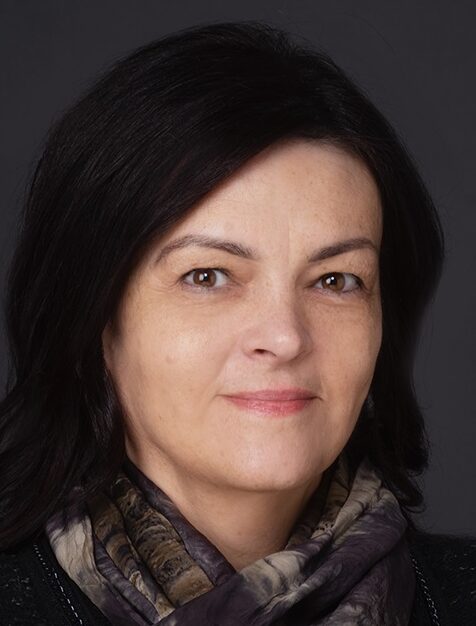
Hungarian–English interpreter Márta Bárány was influential in the creation of both TIS and NAATI, and was AUSIT’s sixth national president (1997–99). In our last issue we announced that Márta had been awarded the NSW Premier’s Interpreters and Translators Medal 2026, and at 93, has no plans to retire soon. French– and Romanian–English freelance translator and editor Cristina Savin, a member of the In Touch Editorial Committee, recently caught up with Márta online to interview her.

So instead of assimilation we started to work on integration … that is when multiculturalism started …
Cristina: Thank you Márta for agreeing to talk to me. Our profession is complex and has been tested over and over again during the past few decades, with more challenges to come.
There’s are so many complexities I’d like to unpack today, but considering your enormous contribution, I prefer to focus on leadership and strategy, while also touching on your work as a language professional and intercultural communicator.
You were born in Hungary and came to Australia after the Second World War. Would you like to share with us some of the early memories that shaped your love for languages and led to you becoming a T&I professional?
Márta: In Hungary the education system was that you had to learn languages, Hungarian is such a unique language. German was a second language we learned in school, and later we learned Latin which is the mother of many languages.
When I went to a Hungarian school in Germany, I learned Hungarian, German, English, Latin and French. It seemed to come easy to me. I was very interested in history and geography but languages came easy to me. That’s how my passion for languages evolved.
When I came to Australia I was able to speak a certain amount of English, but most of the migrants who came here in the ’40s and ’50s did not speak English at all. I wasn’t very fluent in English back then, but I knew the grammar and the basics, and due to my ability to pick up languages easily I built on that foundation and in a couple of years I was fluent in English. People came to me for help when they needed to be understood, so it just evolved naturally.
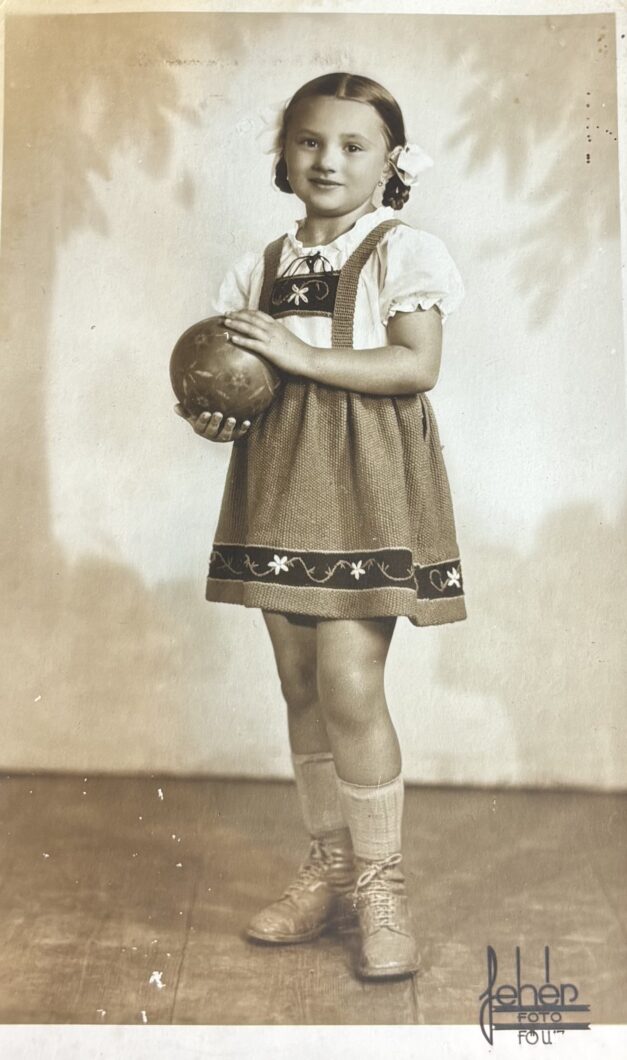
Márta at the age of six
Cristina: Do you work with languages other than Hungarian?
Márta: I used to, but not any more. At one time I worked with German because I lived in Germany for six years and I learned German perfectly, even the dialects, the Bayrischer and the Schwäbischer. But now I don’t speak German with anyone so I’m a bit rusty, and also I’m not NAATI certified in German.
Cristina: You’ve made a significant contribution to multiculturalism in Australia; you also contributed to the establishment of the Telephone Interpreting Service [TIS, now TIS National] and later to the creation of NAATI. Looking back … what were the most challenging moments?
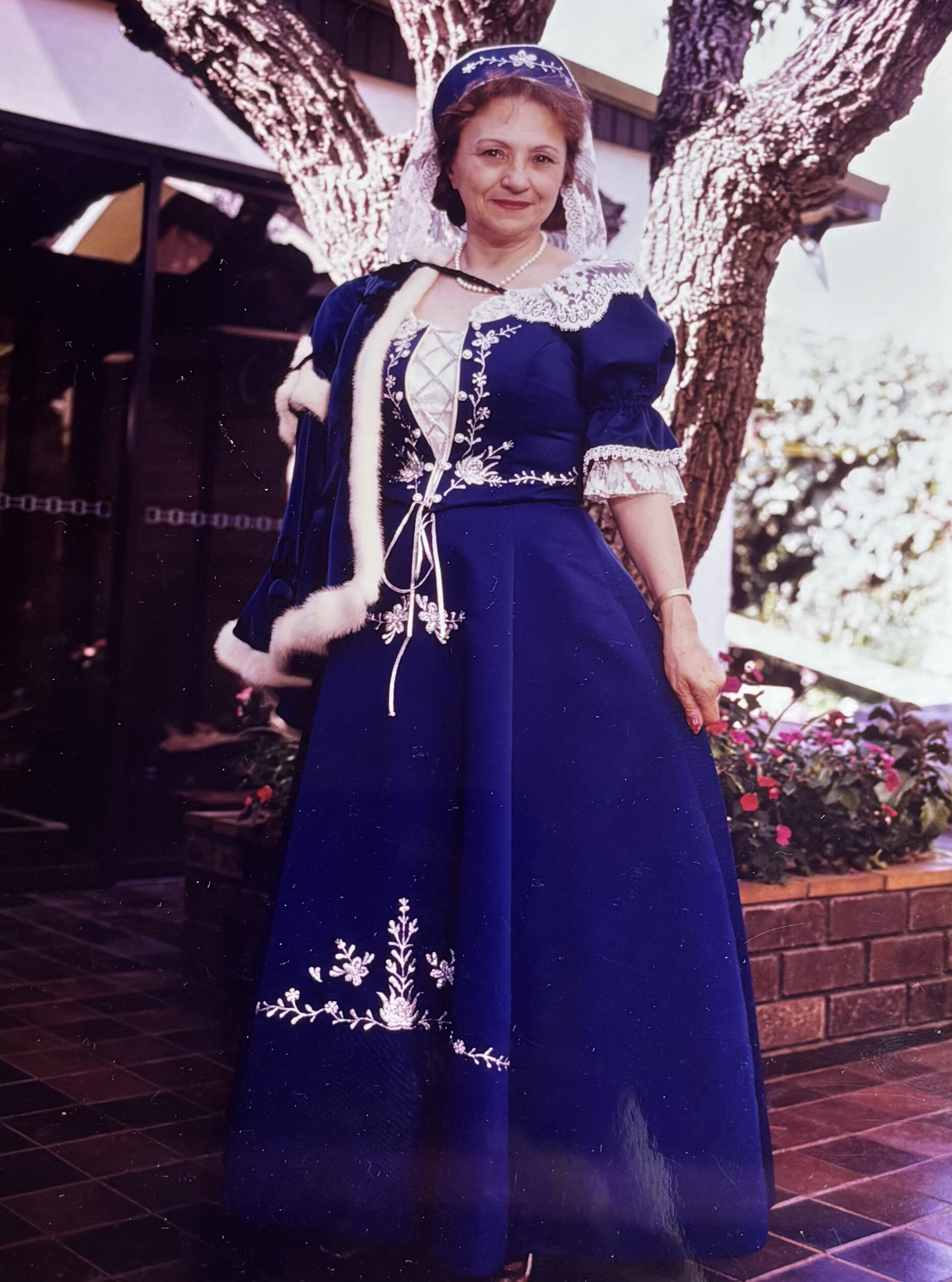
Above: Márta in festive Hungarian costume
Márta: After the Second World War when we came to Australia as migrants, the Australian Government looked at us as a bit of second class, we were not English. Ok we were white, that was important, but second class. Australia needed factory workers very badly, so back in the late ’40s and early ’50s many university-trained labourers worked at BHP, for example. My father was one of them.
In those days we were told we could come here but we had to assimilate and this is something we did not want to do. You had to become white Anglo-Celtic Protestant. I’m white, I’m Protestant but I will never ever be Anglo-Celtic or -Saxon, I’m Hungarian and that’s not going to change.
So instead of assimilation we started to work on integration. And that is when multiculturalism started – integrate people, don’t try to assimilate various European people into being English. So we started to push integration through, and that’s what I started working on in the beginning, and then it evolved. Multiculturalism needed interpreters, so people could express themselves in their own language.
Then the Hungarian Revolution came in 1956, and a lot of Hungarian refugees came to Sydney. With other Hungarians we started Caritas for those people who needed accommodation and other assistance, and because I was able to speak English fluently there was a need for interpreters.
And that’s how my interpreting really started, by volunteering and working for the Hungarian Ladies Auxiliary. I became their social worker and did this work voluntarily, I did not get paid. That’s how I started as an interpreter. There was no community interpreting in Australia.
Also at the time, the local Members of Parliament became quite close with members of their party and the community they represented, they came and talked to us quite freely. Politics was one way open to us to join the Australian society. Billy McMahon was the member for Strathfield when I lived in Burwood back then, so I started to push for an interpreting service through that channel.
Then I joined the Ethnic Communities Council when it was established, and through this we worked on the implementation of TIS. If I remember correctly, TIS was established in 1972.
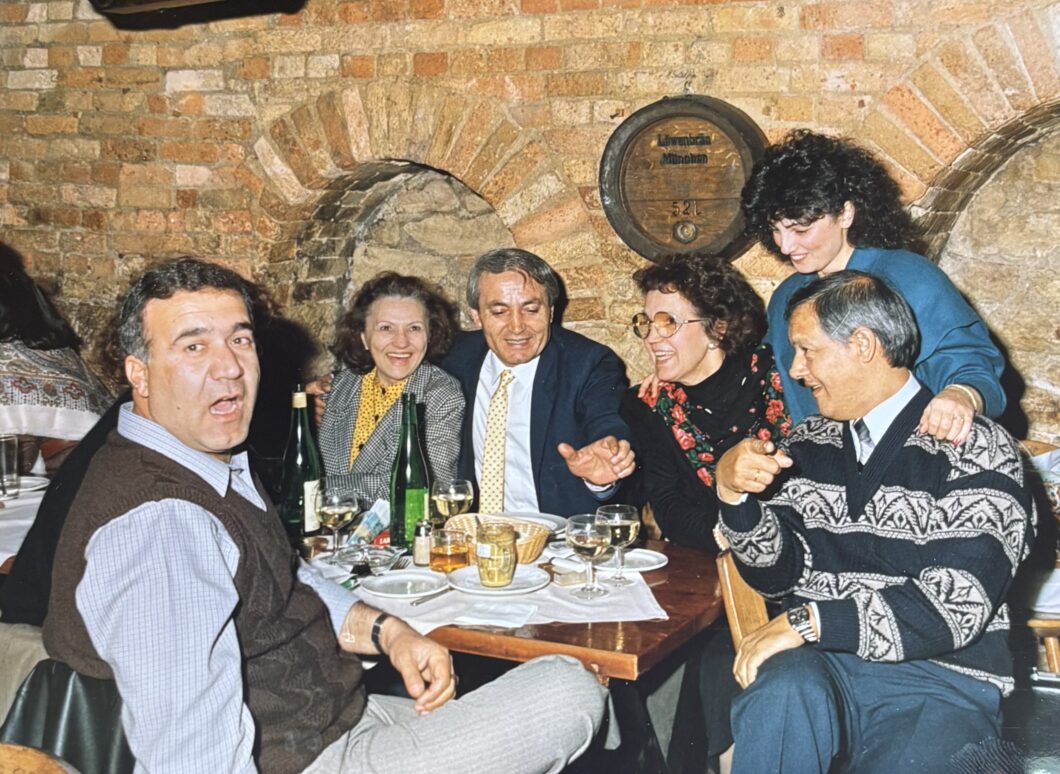
Above: TIS colleagues at a Christmas get-together, clockwise from the left: a Turkish interpreter, Márta, another Turkish interpreter called Kamil, Helen Miller (Serbian), Eva El-Zahoul (Arabic, standing) and Antonio Lemos (Spanish).
The need to have interpreters became evident, but there was no foundation to make it into a profession, so a testing authority became necessary, and that’s how NAATI came into being. A few of us recognised the importance of testing and accreditation for interpreters, but after NAATI, we also needed an organisation to represent professionals, so we started to work on AUSIT.
Then I was elected as the first NSW Branch Secretary of AUSIT. At the time I was working in TIS, when TIS was established I first worked as an outside interpreter, a casual but then I became permanent.
When I reached the age of 65 I had to retire, and I became a freelance professional. By that time my name was quite well known in the profession, so I was able to work for all the services at the time.
Cristina: Clearly you enjoyed it so much, but I imagine those were rather stormy waters, working with politicians, the community, the government, so you must have learned a lot. What were some of the most valuable lessons?
Márta: Yes, we knew that an interpreter was not just a person who spoke two languages. There were people who came to me and asked to become an interpreter because they could speak two languages. I turned them down and explained that to be an interpreter you needed the qualifications, otherwise you would not be taken seriously. We worked to create a meaningful qualification for interpreters. And this is what AUSIT tried to do, make the interpreter a professional, in the same way a doctor or an engineer is a professional.
We worked to create a meaningful qualification for interpreters. And this is what AUSIT tried to do …
Cristina: And our profession should be legislated, if we want to be taken seriously and respected and recognised. I think if we want to be taken seriously in the same way as doctors and engineers, like you said, there should be some form of legislation to recognise us.
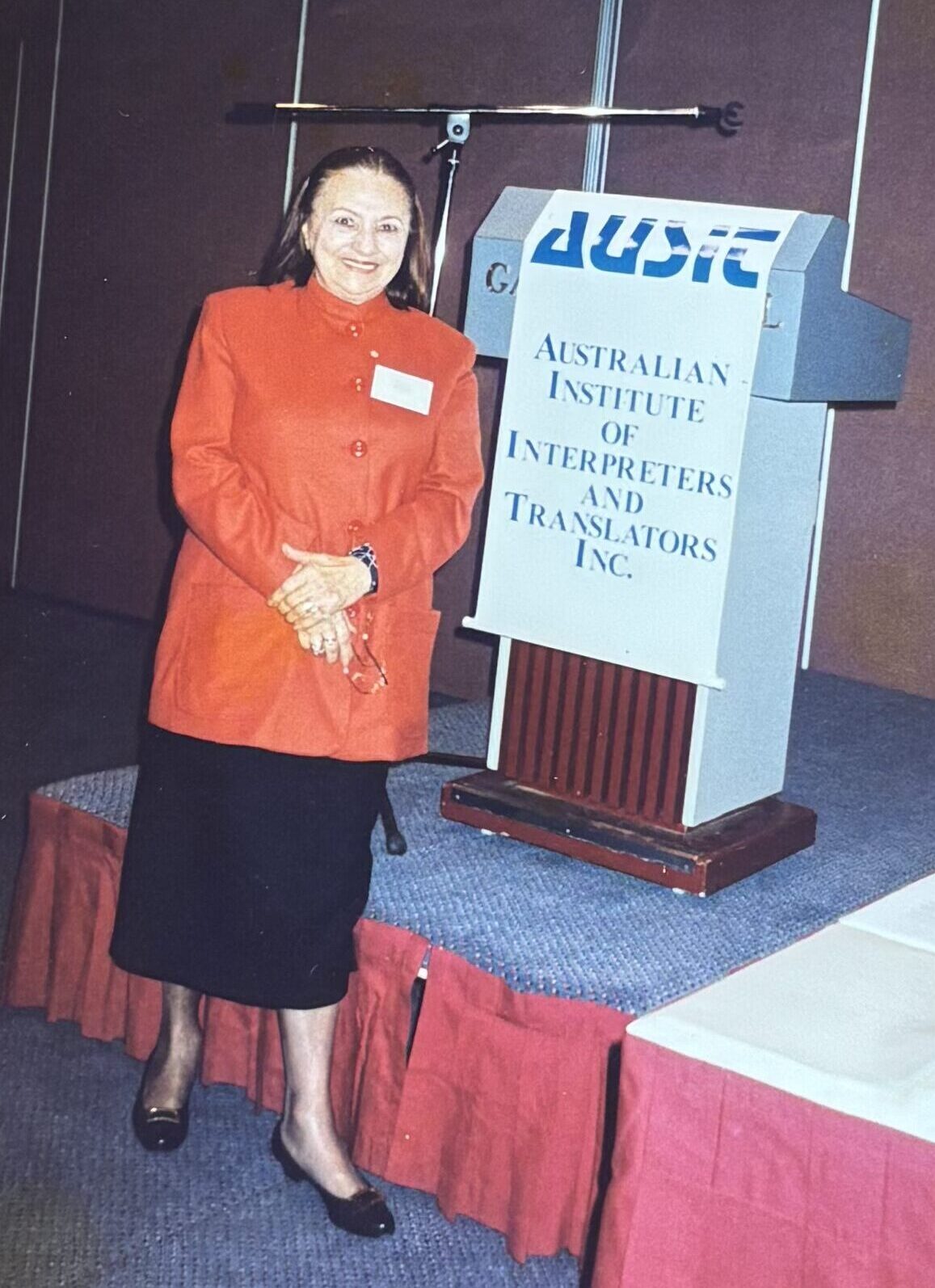
Image: Márta as the AUSIT National President, at the AUSIT National Conference 1999 in Sydney
Márta: That’s correct, I agree with you wholeheartedly. And that was in the mind of those people, likeminded people in NAATI and AUSIT. I was the National President of AUSIT for two years and the Secretary and President of the NSW Branch, and I’ve always worked toward the goal of making interpreting and translating into a recognised profession. That’s my main aim.
Cristina: From what you’ve described so far, it’s no wonder you’ve received a number of awards – the Medal of the Order of Australia in June 1995 in recognition of service to the Hungarian community. You are also the recipient of the British Empire Medal, and I’d like to know more about it. Have you received any other awards?
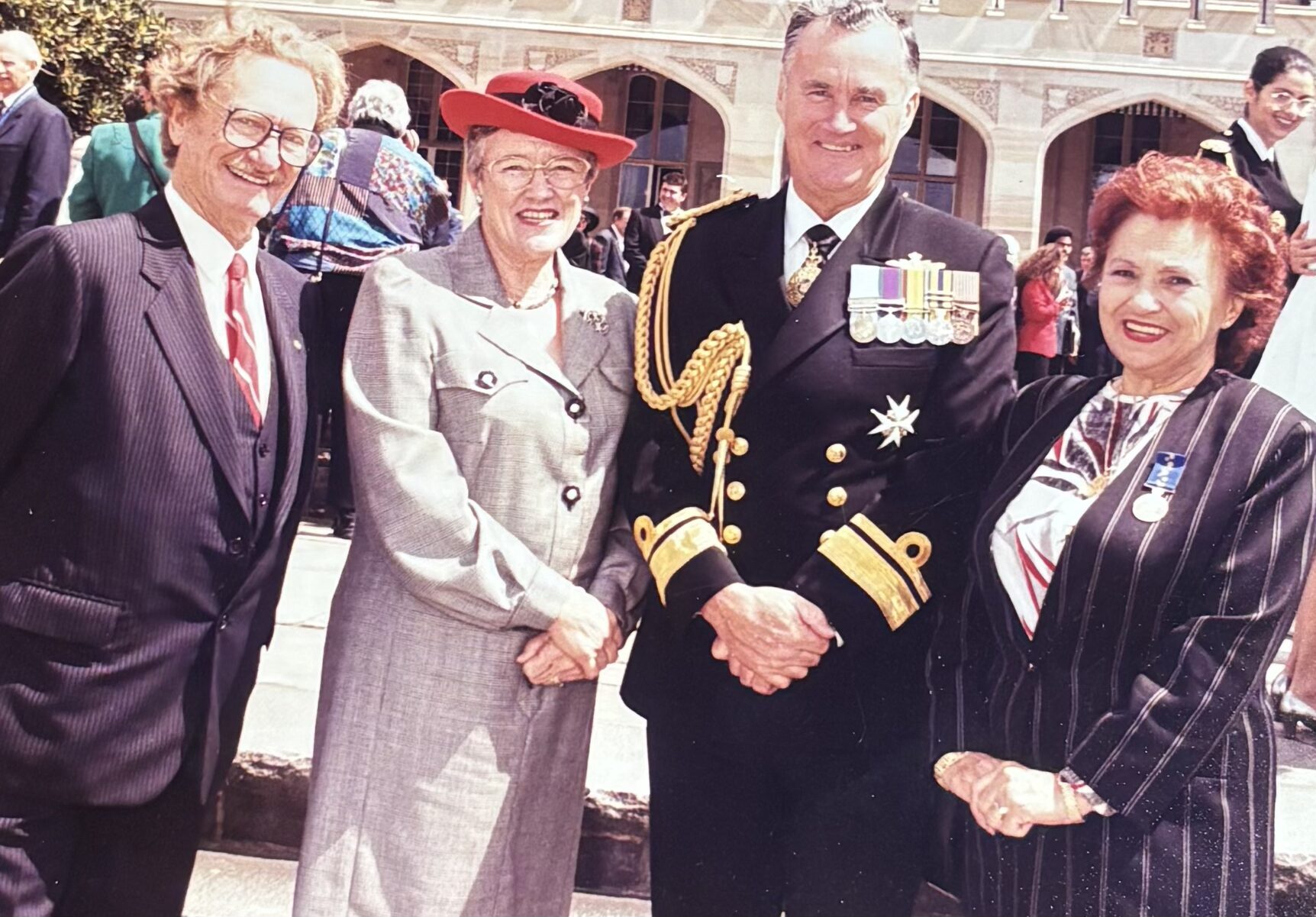
Image: Márta (right) with the then NSW Governor, Rear Admiral Peter Sinclair and his wife, and Márta’s husband Tony (left), at Government House in 1995, after receiving her OAM
Márta: First I received the British Empire Medal, because back in the 1970s Australia did not have its own awards, I think after the Whitlam government the Australian award system came into being. Back then it was the British Empire Awards that Australia used and that’s how I got mine and it was for services to the Hungarian community, and Caritas, but also it was something to do with working in the Australian community.
Cristina: So it was about creating a bridge, a more recognised connection between the two countries, cultures and identities?
Márta: Yes, it had to do with integration. I was starting to become more integrated. I was Hungarian, but also integrated in the Australian community. The Hungarian Government, the Embassy and the Consulate in Sydney knew me, and I received the Gold Cross – Hungary’s highest award – from the Hungarian Government for my work with the Hungarian community.
Cristina: What role would you say all these awards played in your work as a leader in the T&I profession?
Márta: I suppose when I put down my name followed by OAM, BEM, Gold Cross – it gives something extra, it shows that I can be trusted as a person.
Cristina: I think you’re making a very important point, because we as professionals strive as much as we can to get recognition, to elevate the profession and the status of translators and interpreters.
Márta: Exactly, that’s how I look at them as well. People come to me for recommendations and my awards carry a lot of weight.
Cristina: In addition to being a T&I professional, you served as an Ethnic Affairs Commissioner for three years in the 1980s, where you helped shape the foundations of multicultural policy in New South Wales.
This must have been an enormous task – one that required diplomacy and a strategic approach to align government policy with the needs of both the T&I profession and the community. How did you manage to find that balance and influence both?
Márta: At the time the Macedonian question came up, the Greek Macedonian. The second thing was the Bosnian language. There was no such thing as the Bosnian language, in Bosnia there was either Croatian or Serbian. I did have a Serbian colleague and a Croatian colleague in the Ethnic Affairs Commission and they tried to stop having Bosnian language recognised, but the Australian Government wanted Bosnian language recognised. The same happened with Macedonian language – recognition.
I enjoyed going out to various communities. I went to the Sri Lankan community and I said I was Hungarian, and they said we were related because we had Sanskrit language in common, they looked at me as a relative. I went to the Ethiopian community – that was interesting, they have a different concept of time, they are very relaxed, you say 8 am and they show up at 9 am.
Cristina: That’s interesting, Indonesians have something similar, called jam karet – it literally means ‘rubber time’ – a relaxed, flexible attitude to time and punctuality. Cultural differences!
Márta: I went to the Arabic community as well, and I very much enjoyed that because I learned new things about various people, and in my mind that was multiculturalism. I was able to meet these people as friends.
Cristina: It sounds like you took the initiative to go out to communities, which provided an avenue for diplomacy and a way to make it more strategic for governments to gain a better understanding of different ethnic groups and be more flexible and inclusive in their multicultural policies, in understanding the needs of the communities throughout Australia and those of the T&I profession.
Márta: Yes, that’s right. I also want to mention that during my time as the Ethnic Affairs Commissioner, the Commission decided to set the fees for translators and interpreters. I was closely involved in the negotiation process together with the NSW Public Service Association and we were able to set very good terms and conditions. However, since then other services, especially the private ones, have lowered their fees, which prompted Multicultural Affairs to lower their fees as well.
Cristina: Let’s talk a little about your work as an interpreter … what was the most interesting project you’ve ever done? And the hardest?
Márta: I talked about this the other week, I was interviewed on the SBS Insight program, they are going to show it in August. I told them about a case, I was working in TIS late at night and a call came from a small hospital in Western Australia. A woman was giving birth and I had to interpret everything the doctor told her to do. She had the baby but the nicest part was that I had to tell the father ‘You have a lovely boy’.
Cristina: How lovely! The doctor delivered the baby, and you delivered the news to the father.
Márta: The hardest assignment was when I had to tell someone about a death. I worked for an English company, it was a night call because of the time difference. At the time there were many Hungarians working in the UK, when the UK was part of the European Union. There were Hungarian bus drivers working in the UK and I had to tell a father who worked as a bus driver in Glasgow that his son was dead, he was knifed to death at the local bus stop. That was hard.
Another was when I had to tell a Hungarian truck driver in the UK that he caused an accident and the other driver involved had died. He was being arrested for negligence and he was heartbroken. Yes, those were the hardest, telling people about someone dying.
Another memorable task was with an assisted suicide situation, the person wanted to die when the Hungarian national anthem was being played. And she got the injection.
Cristina: This is heartbreaking but I guess you have to respect one’s wishes …
Márta: Yes, you do.
Cristina: Over the last few decades in the T&I profession, you have witnessed major changes. How do you see our profession shift and hopefully grow in the next five to ten years?
Márta: I don’t see any signs of it getting better. As a NAATI examiner I feel we are stuck at a certain level, we plateaued. The problem is that there are a lot of rare languages and even dialects where you cannot find a professional, a certified interpreter. As you know, our interpreting services are predominantly community oriented and we need to serve all community groups, including those who speak rare languages and dialects. But there are no formal university courses to train interpreters in those languages, so the community relies on people who are not trained professionals. And because of this we cannot have a fully qualified profession, which is holding us back from becoming a fully recognised profession. This situation pulls the whole profession down. I feel this is a problem and I have no solution to this.
Cristina: I want to say a huge ‘Thank you!’ This has been so amazing and I’m so grateful to you for sharing all this with me, it’s a treasure trove of knowledge – getting a glimpse into your contribution as a T&I professional and the way you’ve helped shape multiculturalism in Australia.
Do you know a longstanding AUSIT member who has made significant contributions to AUSIT and/or the T&I profession? Would you like to interview them for this series? Just get ‘in touch’ with one of our editors or an Editorial Committee member (see page 2), and we’ll take it from there.