




ADVOCACY
In our first issue of this year we published an article by the chair of AUSIT’s Advocacy Committee, Patricia Evelin Arguello de Avila, exhorting members to become advocates for our profession and giving tips on how* – so it’s pleasing that in our last issue of 2025 Patti is returning to tell us how the Committee’s efforts are paying off – via PD-INTERP, a very significant development announced in late November.
* You can read Patti’s first article here.

The Federal Circuit and Family Court of Australia (FCFCOA) – which has jurisdiction over both family and federal law matters – has issued a new ‘practice direction’ on working with interpreters.
Practice directions supplement laws and court rules; they are binding guidelines/orders that provide practical instructions for legal processes, to ensure consistent application of procedural rules.
QLD Branch Committee and the AUSIT Advocacy Committee are in the process of writing a heartfelt ‘Thank you!’ message to the Queensland Law Society for helping publicise PD-INTERP via their weekly newsletter, Proctor – you can read their report here.
Both AUSIT committees are hopeful that, with this direct guidance, courts in QLD and around the country will fast become more mindful about the correct process for booking interpreters for court work, and about how to work effectively with interpreters during trials, hearings and proceedings.
PD-INTERP directs all judicial officers and others involved with booking interpreters to follow best practice as laid out in the Recommended National Standards for Working with Interpreters in Australian Courts and Tribunals, which AUSIT has been promoting since its first edition was published in 2017.
With the FCFCOA – the largest court in the country – ruling on best practice, we need to seize the momentum and do our bit too: as interpreters working in the courts we must become familiar with the Recommended National Standards, in order to speak with gravitas to all those involved in the process of employing interpreters to work in courts – including language service providers – when requesting the necessary equipment and other resources.
I routinely carry a hard copy of the Recommended National Standards when I work in the courts – I will now carry a copy of PD-INTERP under my arm as well, and I advise you to do the same.
And wait … there’s more … if/when you have a spare moment, why not write to congratulate QLD Law Society fpr promoting PD-INTERP – here’s the link again. They deserve our support.
Happy sailing!
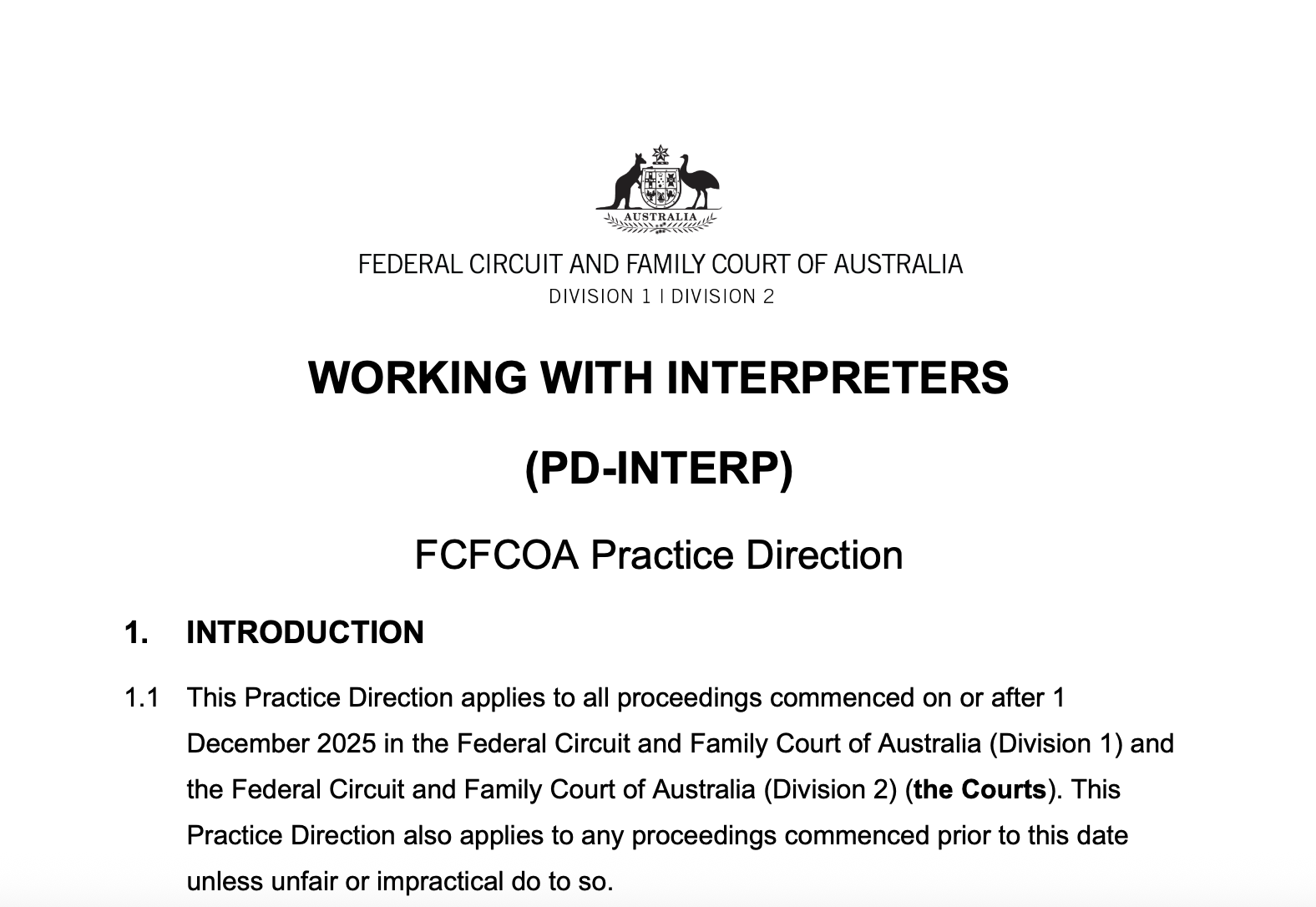
You can read the full PD-INTERP here.
Patricia Evelin Arguello de Avila went to school in Washington, DC. Living with her aunt, the head translator for the World Bank’s magazine Finances & Development, she developed a passion for T&I that has led to a life-long professional career, based in Brisbane. Patricia is a NAATI-certified Spanish interpreter specialising in legal and medical interpreting. She also holds a diploma in legal studies and is an Associate Member of the QLD Law Society. She currently chairs AUSIT’s Advocacy Committee, as well as representing AUSIT and her profession to numerous state-based bodies.