


BOOK REVIEW
by Jen Calleja
reviewed by Elizabeth Ambrose
‘What makes Fair unique is its form. Calleja has crafted this book in a wonderfully imaginative way …’
I had never heard of Jen Calleja before reading her latest book, Fair: The Life- Art of Translation.
It turns out that she is an accomplished writer, literary translator (German–English), editor, publisher, and drummer in a punk band. Fair is a testament to both her creativity and her extensive knowledge of – and passion for – literature.
What makes Fair unique is its form. Calleja has crafted this book in a wonderfully imaginative way, using the concept of a book trade fair (and occasionally a funfair) as a sort of metaphor for her life and career as a literary translator. Each short episode (one to three pages in length) recounts or depicts a separate incident or moment, and corresponds to an area of the fictional book fair. Calleja guides the reader from stand to stand, through the corridors of her life and career. The book is episodic by design (there is no traditional narrative and no development of other characters, although she fleetingly refers to the many people with whom she has worked), which means that the reader can step in and out of the book at leisure.
Above all else, Fair is a full-scale denunciation of the unfair pay and work conditions for literary translators. Calleja lets rip, targeting the practices and attitudes towards translators that are dominant within the publishing industry. Her litany of complaints includes not only the insecurity of freelance work and the low pay (incommensurate with her qualifications, skills and time taken to do the task), but also the snobbery that she has regularly confronted as someone from a working-class migrant family, clearly stating, ‘Yes, I have a chip on my shoulder.’
Like many specialised translators, Calleja is qualified in both translation and another field, and bemoans the double-barrelled insult of the disregard for not only her language skills (literary translators are often not named on book covers), but also for her expertise in her field of specialisation – literature. Literary translators in particular will be able to relate to her frustration as she grapples with the tension between the traditional view of the translator as an (invisible) service provider on the one hand, and an alternative viewpoint that sees the literary translator as an artist who constructs something new from someone else’s creation.
Overall, Fair is an important work which gives a loud and brave voice to literary translators. Jen Calleja is to be commended for calling out unfair practices, and doing so in a way that in itself overwhelmingly demonstrates her artistry.
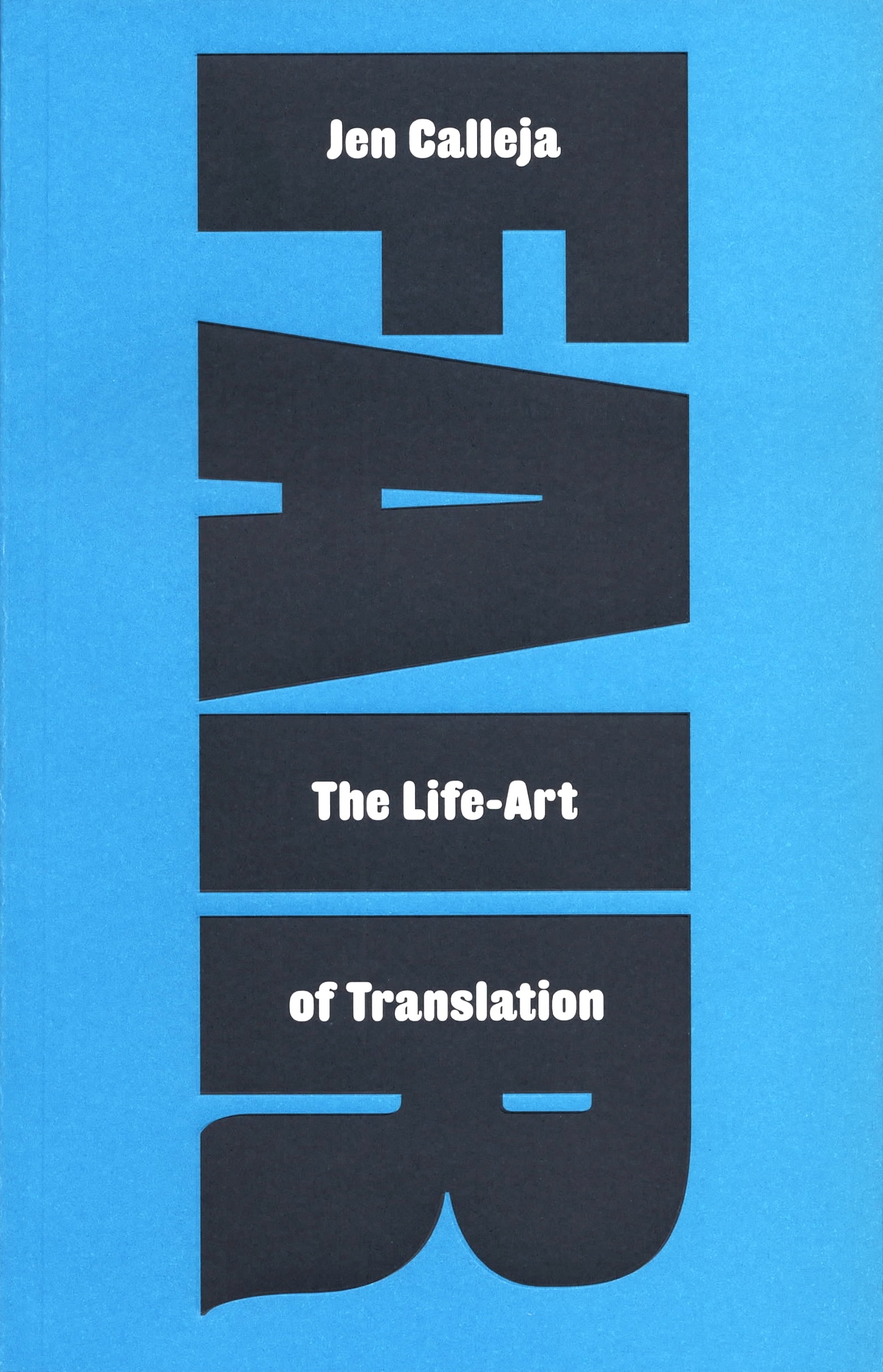
Cover reproduced courtesy of Prototype Publishing

Elizabeth Ambrose is a French–English translator. Having obtained both a law degree and a translation qualification, she specialised mainly in legal translation, and now works as a scientific editor at the World Meteorological Organization in Geneva. Elizabeth has always been interested in what she considers to be the enigmatic field of literary translation.