



BOOK REVIEW
by Siang Lu
reviewed by Marta Menendez
‘… a fascinating exploration of how language constructs – and deconstructs – identity, power and reality.’
Ghost Cities offers readers a rich linguistic playground in which satire, translation mishaps and myth-making are woven into a layered narrative that challenges our understanding of both language and meaning.
From a linguist’s perspective, this Miles Franklin Award-winning new novel by author Siang Lu is a fascinating exploration of how language constructs – and deconstructs – identity, power and reality. Its dual timelines, one set in modern-day Sydney and the other in ancient China, are bound by a shared obsession with translation, censorship and narrative control.
The modern-day protagonist, Xiang Lu, is fired from his job as a translator after it’s revealed he relies entirely on Google Translate and doesn’t actually speak Chinese – an absurd premise which critiques linguistic authenticity and the commodification of cultural identity in a globalised world.
Xiang’s viral fame as #BadChinese underscores how language proficiency – or the lack thereof – can become a spectacle, a brand, and a tool for manipulation in digital culture.
In the ancient timeline, Emperor Lu Huang Du’s destruction of the Imperial Library and exile of scholars who fail to glorify him in their texts reflects the politics of translation and censorship. Language is shown as a weapon of control, as only sanctioned narratives survive; meanwhile a quest – by the Emperor’s concubine, Wuer – to recreate lost texts becomes a metaphor for linguistic preservation and resistance against erasure.
Lu’s narrative is deeply polyphonic, echoing his debut novel The Whitewash. Characters speak in conflicting registers and stories loop back on themselves, creating a tapestry of linguistic ambiguity, while the fictional ‘ghost city’ Port Man Tou is a literal and figurative stage on which language, performance and reality blur.
The novel probes the limits of language: What happens when translation fails? Or when stories are manipulated? And how about when meaning is manufactured? These questions resonate deeply with linguistic theory, especially in the realms of semiotics and sociolinguistics.
In sum, Ghost Cities is not just a novel – it’s a linguistic labyrinth. For readers attuned to the nuances of language, it offers a witty, layered and thought-provoking journey through the politics and poetics of communication.
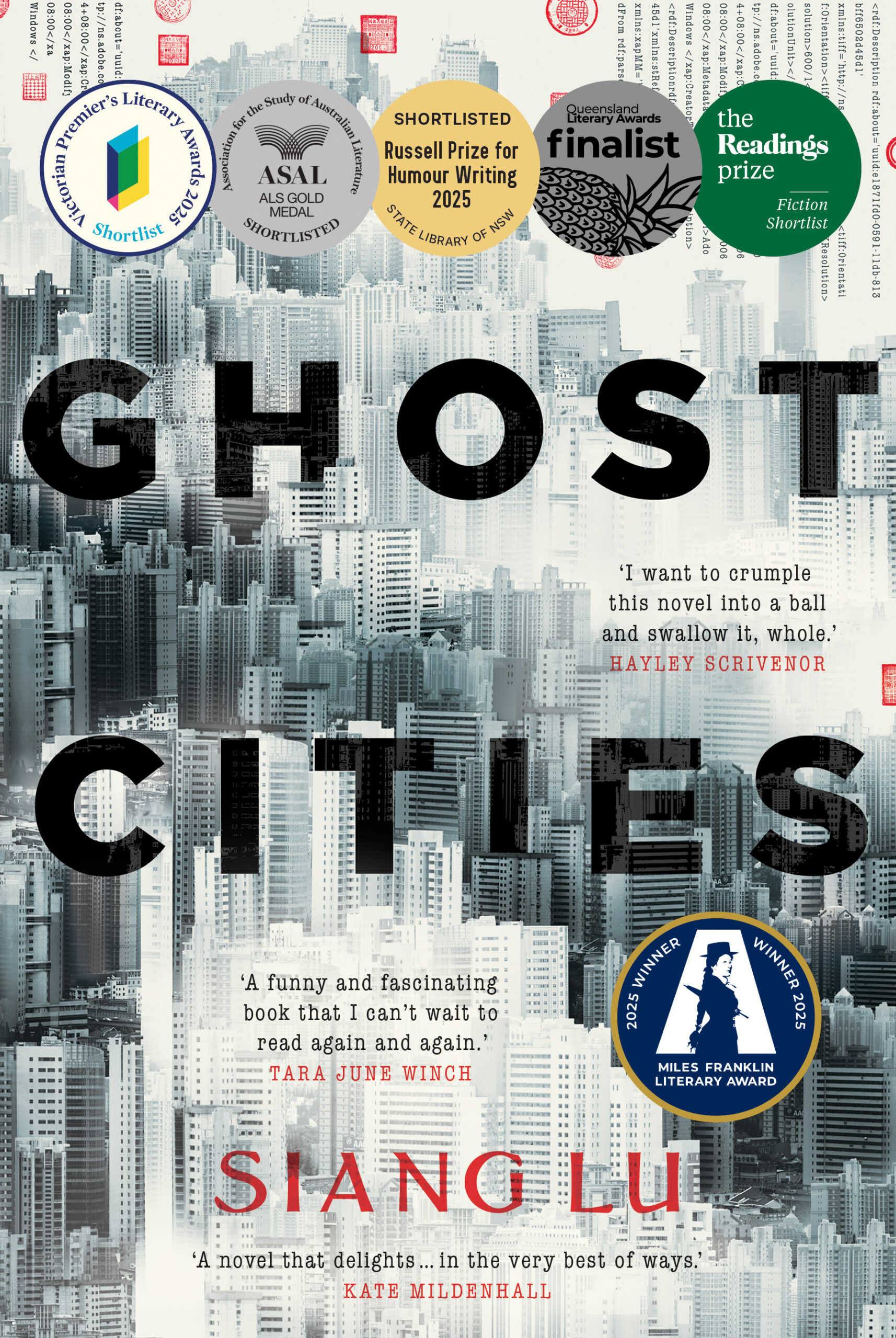
Cover reproduced courtesy of Prototype Publishing

Marta Menendez was born in Buenos Aires, Argentina, and came to Australia in 1984. She graduated from Western Sydney University as a certified interpreter and translator in 1999, and since then has completed a Master of Social Policy degree followed by a Master of Interpreting and Translation, both also at Western Sydney University. Marta works as a freelance interpreter and translator (Spanish<>English), and from 2003 to 2025 she was engaged by Western Sydney University as an tutor in interpreting and translation.
.