


INDIGENOUS LANGUAGES
Lauren Campbell (a project officer with NAATI’s Indigenous Interpreting Project) and Sylvia Tkac (an interpreter for Anindilyakwa, the community language of the Groote Eylandt Archipelago, working for the Aboriginal Interpreter Service NT) recently visited the Euskal Herria (Basque-speaking country) in Spain and France, to find out how translation and interpreting has contributed to the revitalisation of Euskera (the Basque language). They report here on the experience, and reflect on what learnings they can apply in Australia.

They were everywhere: Language lovers! Language professionals! And lots of translators and interpreters!
From Groote Eylandt and Melbourne to Euskal Herria
In September and October 2025, we were lucky to be chosen to spend two and a half weeks in the Basque Country as guest participants in the Aditu (‘expert’) program on minority language activism run by Garabide, a Basque non-governmental development organisation that promotes the revitalisation of endangered languages worldwide. The course – designed to share the Basque experience and create opportunities for knowledge exchange between indigenous language speakers and advocates – brought us together with other participants from Mexico, Ecuador, Bolivia, Morocco, Equatorial Guinea and Haiti. Just being in a room with such a group was energising, and they were all very interested to hear from Sylvia about the Anindilyakwa language community from Groote Eylandt, Northern Territory.
We visited immersion schools, government offices, media outlets and cultural organisations – and we were blown away. They were everywhere: Language lovers! Language professionals! And lots of translators and interpreters!
A language revitalisation success story in the face of a colonial language
Basque speakers have similar stories to Aboriginal and Torres Strait Islander people and the other indigenous participants on the course. For many years their language, Euskera, was banned in the public domain and kids were punished if they spoke it at school. They told us about running illegal language schools in their homes to hide from police, and shared the huge pride they feel now that all children go to immersion schools, where Spanish language is only introduced in Grade 3. As a result, they can now boast that 75% of 16-to-24-year-olds in the autonomous Basque region in Spain are fluent speakers. This significant outcome results from a huge collective effort which transformed a strong grassroots movement into a network of organisations and sectors that are well organised, funded and supported. Many impressive initiatives make up a whole ecosystem that sustains the language and its speakers.
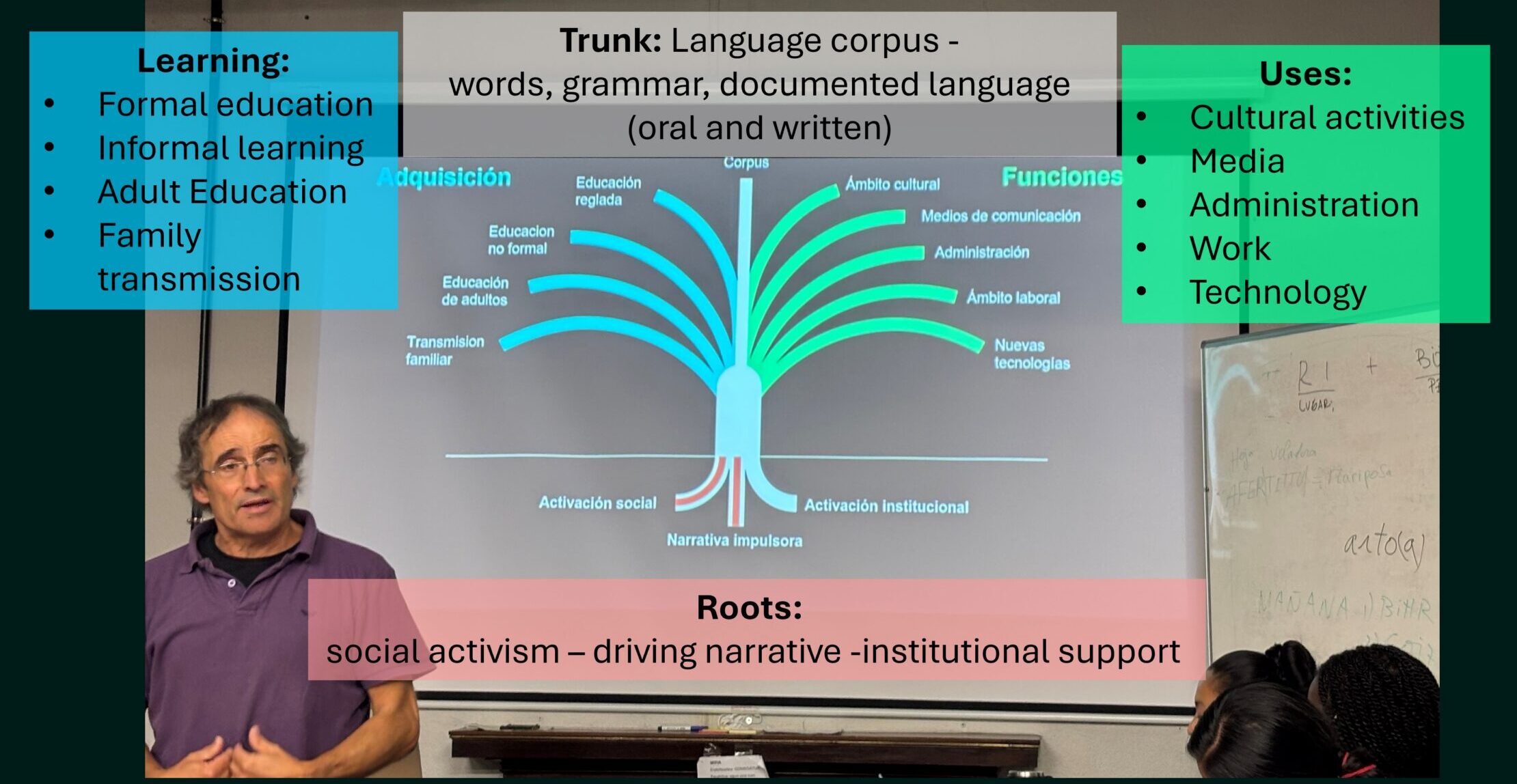
Viewing the ‘language tree’ that the Aditu program is based on showed us everything a language needs to stay strong. It’s complex!
While translators and interpreters don’t have their own branch on the tree, their work is important to all the branches, as they make possible the catch phrase ‘Euskaraz bizi nahi dugu!’ (‘I want to live in Euskera [the Basque language]!’)
Translators: access, resources and visibility
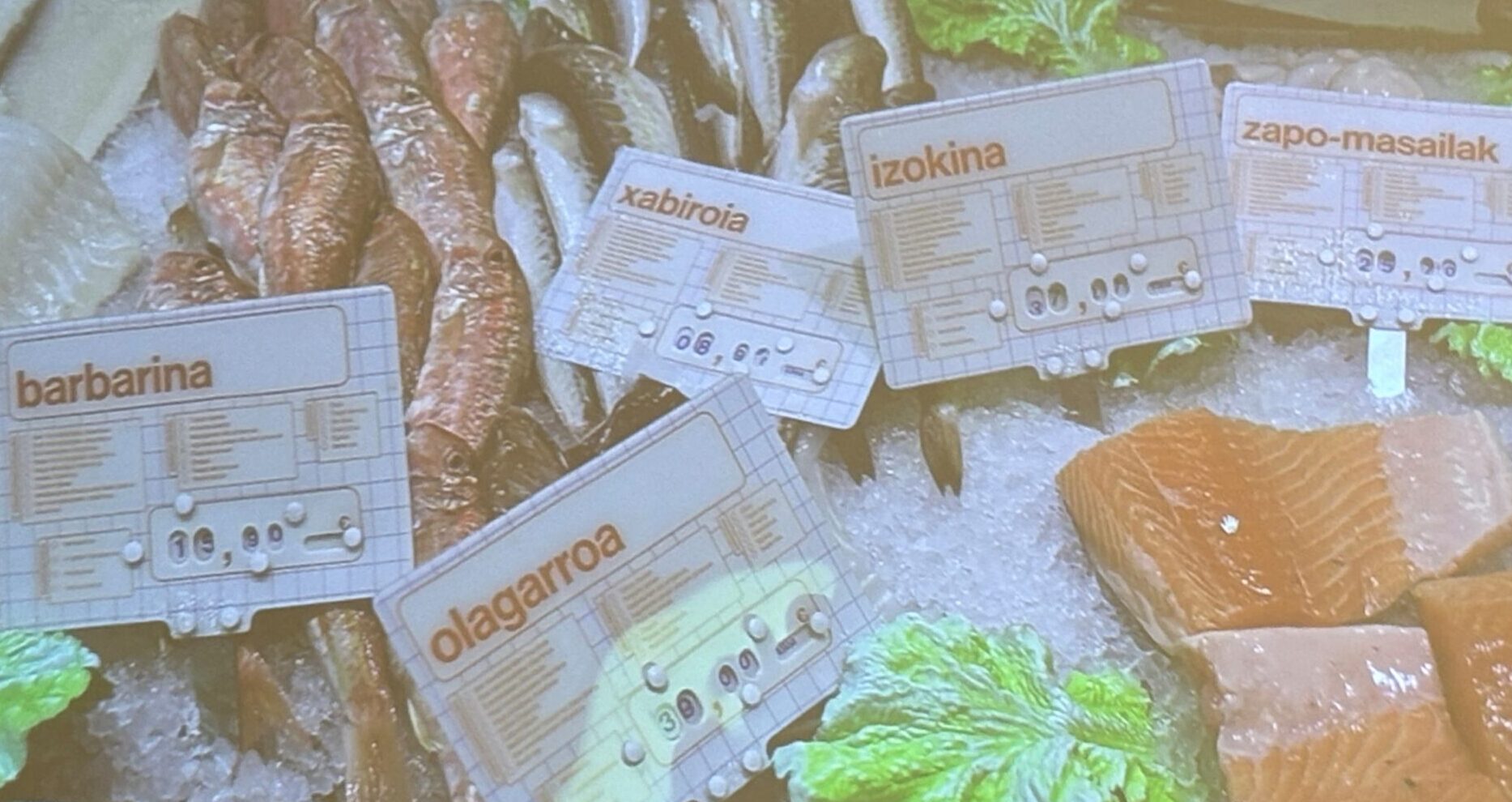
Translators have now been employed in Basque Country for decades, to ensure not only that information is available in Euskera for those who speak it, but also that it’s seen in public by all. Translators work in all levels of government, in the media and education, in publishing resources, translating apps and online platforms, and in cultural organisations. We heard about a great project last year that helped all fishmongers to get price labels produced with the fish names in Basque, and this year’s project is focusing on bakeries.
In Australia, translation requests for Aboriginal and Torres Strait Islander languages are increasing. For many Australian Indigenous languages, including Anindilyakwa, not all speakers are confident readers or their language, but having good translations and signs in Language will raise its profile by pushing it into the everyday landscape and giving people the opportunity to learn and be proud.
Translators are often the first to grapple with an official language version of new terms and concepts. In Basque Country, we saw how those working in media outlets fed into the UZEI terminology centre’s database to continually update their corpus. In Australia, every document – whether it’s a new Centrelink policy or a mining contract – is full of translation challenges, particularly for Aboriginal and Torres Strait Islander languages. Rarely are there easy conceptual equivalents! Translating them is tough, but such an important part of a language staying relevant and growing with the times. We have a long way to go in Anindilyakwa before we are as coordinated in building a connected database and terminology bank for language workers and the community to share.
Interpreters: access, freedom to choose to stay ‘living in language’
We’ve always known that interpreters play a massive role in enabling language rights and access to services and justice. Some people don’t realise, though, that interpreters are in an amazing position to learn and go broad and deep into our languages, working across many topics and listening to a wide variety of speakers. This kind of knowledge is a great resource for a language.
In Basque Country, interpreters don’t do as much day-to-day health and legal service work as on Groote Eylandt, as fewer people face a language barrier. A lot of government services are delivered in Euskera, and everyone there becomes fluent in Spanish (or French in the northern part of Basque Country). Instead, interpreters are often engaged to make sure that Basque speakers can choose to speak Basque, particularly in public forums. They do more interpreting at meetings and conferences, making sure that more speakers can continue in Basque, even when non-speakers are present.
One guest speaker on the Aditu program made the point that if we all switched to the dominant language as soon as one non-speaker joined a group, our personal language spaces where we can use our minority/Indigenous language very quickly disappear. It may feel like the polite thing to do, but maybe we need more workarounds. They encouraged more use of casual interpreting in social settings, and simultaneous interpreting (SI) set-ups in formal/structured settings. They also showed us you don’t necessarily need SI radio equipment, you can also achieve this with Telegram or WhatsApp channels. It’s also OK for a Spanish- or English-speaker to listen and try to learn!
We discussed how this could happen with more of the meetings on Groote Eylandt that quickly switch to English. Few non-Indigenous people learn to speak Anindilyakwa fluently, and hearing the language more also gives them more opportunities to learn. Both Anindilyakwa and Basque have the reputation among non-native speakers of being ‘hard’ languages to learn, but the Basques are changing that narrative. It’s just different! Give people the education, the motivation and opportunities to use a language and they will!
Be proud of your contribution to your language!
Translators and interpreters in Aboriginal and Torres Strait Islander languages sometimes forget to look up from the current assignment and see the impact of our work on the strength of our languages. We don’t just transfer messages into another language, we grow the language, support all the other branches, raise the profile, and make our languages seen and heard!
We would like to thank Erika Gonzalez (RMIT), NAATI, Aboriginal Interpreting Service NT and Garabide for the opportunity and support to attend the Aditu program. We hope it paves the way for more Aboriginal and Torres Strait Islander T&I practitioners to engage in this kind of experience and learning, and grow in confidence as language activists!
Lauren Campbell works in NAATI’s IIP team, running certification testing for interpreters of Aboriginal and Torres Strait Islander languages. Prior to that, she was a trainer and then training manager at the NT Aboriginal Interpreter Service, where she met and worked with Sylvia. With a background in linguistics and adult education, she has worked in language documentation and language-learning programs with Gurindji and Bilinarra language groups from the NT. Lauren also speaks Spanish, and interpreted for Sylvia during the trip to Basque Country.
Sylvia Tkac is an Anindilyakwa woman from Bickerton Island, NT, and a NAATI-certified interpreter (CPI) in Anindilyakwa. Based on Groote Eylandt, she works for the Aboriginal Interpreter Service NT, regularly interpreting for courts, police and health assignments, and recruiting and supporting new interpreters. Sylvia also does translation work, and has worked at the Groote Eylandt Language Centre.