


From your National President
Esteemed Members, Colleagues:
It is wonderful to connect with you again and share some exciting developments in AUSIT and the wider translation and interpreting community.
AUSIT: what's in a name?
AUSIT has now been in existence for 39 years, and naturally, like all organisations, it has evolved and grown over time. As many of you will remember, last November at the National AGM, AUSIT members voted unanimously to accept various Special Resolutions (intended to give effect to a resolution passed at the 2024 AGM), thereby approving a change to AUSIT’s legal structure – from an incorporated association called the Australian Institute of Interpreters & Translators Incorporated, to a company limited by guarantee called the Australian Institute of Interpreters & Translators Limited (AUSIT Limited).
The new legal structure was accompanied by some appropriate changes to AUSIT’s constitution, and for those of you who are new to AUSIT or didn’t take an active part in this process, you can find some explanatory notes here.
For most members these changes will have no impact whatsoever; our other company details remain the same and in all other respects, business is as usual at AUSIT Limited (or AUSIT as we will continue to be known). We just felt we should formally let you know that the change has been completed.
UNSW T&I at 20: reflecting on the past, responding to change
On 5 May, the University of New South Wales celebrated the twentieth anniversary of its T&I program with a panel discussion on how the changing needs of the T&I industry impact the training of professionals. The occasion brought together faculty, alumni, students, practitioners and guests to reflect on the program’s history and the challenges ahead. Elaine (Min) Wu, NSW Branch’s PD Coordinator and UNSW alumnus, represented AUSIT on the panel.
Professor Ludmila Stern (UNSW) spoke about the program’s history, reminding the room that it was built through vision, persistence and long-term commitment. Professor Sandra Hale (UNSW) then addressed the challenges faced over time, including advocating for formal T&I education, shifting student demographics, new languages and training models, pressures from AI, and broader changes in higher education.
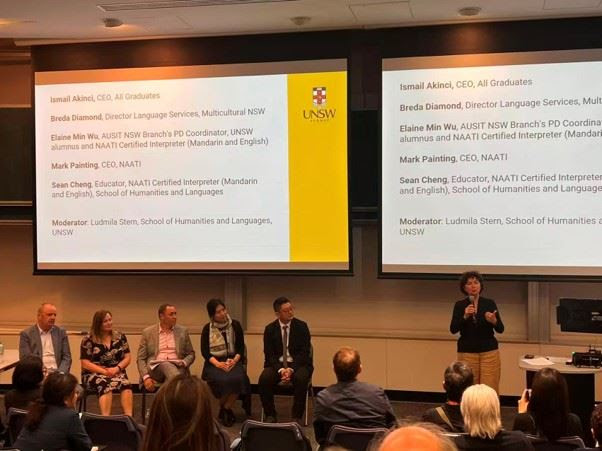
The panel then turned to the present and future. Ismail Akinci (All Graduates) spoke about growing market demand and the impact of technology. Breda Diamond (Multicultural NSW) reflected on public-sector language provision and the importance of training pathways for underserved languages. Sean Cheng (UNSW) addressed preparing graduates with both competence and confidence. Mark Painting (NAATI) highlighted the implications of industry change for certification and the need to ensure practitioners are fit for increasingly complex practice.
A clear message emerged: the future of the profession cannot be shaped by universities, industry, government and professional bodies working in isolation – ongoing collaboration is required between educators, employers, certifying bodies, practitioners and service users.
The discussion also underscored that professional development does not end at graduation. Growth into a professional identity takes time, practice and resilience – navigating uncertainty and developing judgement in demanding real-world settings. This is where organisations like AUSIT remain vital, supporting graduates through development, networking and mentoring as they transition from student to colleague.
As the evening made clear, the strengths sustaining the profession are not only technical. Accuracy and skill are essential, but so too are ethics, judgement and adaptability. The anniversary was both a celebration of two decades of achievement and a timely reminder that the profession’s future depends on how well we support practitioners after they leave the classroom.
Claims of interpreter shortages in Queensland
I have lodged a formal complaint with the ABC regarding an article published on 30 April concerning claimed interpreter shortages in Queensland and the risks posed to non-English speakers in court proceedings.
While AUSIT acknowledges the public importance of the subject matter, we are deeply concerned that the reporter failed entirely to seek comment from AUSIT, from any NAATI-certified interpreter, or from any other professional body with direct expertise in this field.
A LinkedIn post I published on this matter attracted more than 4,000 impressions within 24 hours – including over 100 reactions and 26 reposts – reflecting the widespread concern this issue has generated among practitioners across Australia and internationally.
The ABC’s own Editorial Policies require that the ABC gather and present news and information with due impartiality, and that it make reasonable efforts to represent the views of relevant stakeholders, particularly on matters of controversy or contention. The interpreter profession – its standards, its working conditions, and the systemic pressures it faces – is precisely such a matter. Publishing on this topic without consulting either the professional association or a single practising interpreter falls squarely below the standard the ABC’s own Code of Practice demands.
The absence of professional perspectives allowed the article to present an incomplete narrative that risks mischaracterising both the nature of the shortage and the profession itself. AUSIT members are highly trained, qualified professionals who work under significant pressure in high-stakes legal settings. They deserve to have their voice represented in coverage that directly concerns their work and their profession’s reputation.
AUSIT is committed to constructive engagement with the ABC on matters affecting our profession and the communities we serve. I am currently working with the reporter to provide expert commentary, background briefing, and referrals to appropriate practitioners to assist in any corrective reporting.
Formation of the Australian Veterans Linguist Association (AVLA)
The Australian Veterans Linguist Association (AVLA) has been formed as a not-for-profit charity organisation dedicated to uniting current and former Defence linguists across Australia.
Practitioner-led and future-focused, the AVLA exists to support the welfare, professional development and community of both serving and ex-serving linguists and language enthusiasts from Defence Australia – keeping people connected, skills current, and hard-won knowledge alive long after service ends.
Working alongside Defence rather than within it, the Association advocates for its members, partners with industry, and builds vital bridges between the Defence community and the broader public through networking opportunities, mentorship, cultural engagement and access to industry training.
While membership registrations are not yet open, those wishing to be part of this new and growing community are encouraged to register their interest through the AVLA’s Membership page.
Feedback on AUSIT's advocacy against the increasing use of telephone interpreting in courts
In November 2025 – aided by the Advocacy Committee, who initiated this campaign – I wrote to courts, tribunals and legal bodies across Australia to raise serious concerns about the increasing use of telephone interpreting in court proceedings.
The letter called for in-person interpreting to remain the norm for all but the briefest procedural matters, for video-based interpreting to be adopted as the minimum standard for remote proceedings, and for hearing loop receivers and simultaneous interpreting equipment to be made readily available.
We are pleased to report that this advocacy work has generated a significant number of responses from courts and government bodies across the country, and the overall response was encouraging. Respondents thanked AUSIT, and a number expressed interest in further dialogue.
There was broad consensus that in-person interpreting is the preferred standard and that telephone interpreting should be reserved for exceptional circumstances only.
Some courts explained that although they request in-person interpreters, they are often not available or receive last minute requests from interpreters to switch to telephone interpreting. AUSIT will need to investigate further to better understand the extent to which telephone interpreting is being requested by courts versus requested by interpreters themselves.
Several respondents confirmed that video-conferencing technology is already available across their court facilities and expressed support for its use as the minimum standard when in-person attendance is not possible.
Some bodies indicated that they are actively reviewing their interpreter policies and procedures, with the NSW Attorney-General’s office noting that our feedback ‘will inform ongoing work to improve interpreting practice’ in their jurisdiction.
On the specific issues raised, a number of bodies confirmed that hearing loops are available upon request. We remind all interpreters that in addition to being familiar with the Recommended National Standards for Working with Interpreters in Courts and Tribunals, it is important to proactively request hearing loops as all courts have this equipment (and also to request simultaneous interpreting equipment when attending a court that has this available). Hearing loops are essential to the work of interpreters in court, as they make it possible to hear the voices of all participants in the court process and therefore ensure accurate interpreting.
If you are unfamiliar with how to use a hearing loop or do not feel comfortable asking for one, click on the following link to read or download our short PDF explaining what a hearing loop is and how to use it: Hearing loops for use in court.
AUSIT will continue to engage with all relevant bodies, and will provide further updates as this important advocacy work progresses.
Members are encouraged to write to courts in their local jurisdiction to request access to this equipment if it is not available for them. I also encourage you to pass on the message to colleagues about this equipment, as many still do not know that it exists and how useful it is. It is especially useful in mitigating interpreter fatigue, and strain in the throat and lower back from delivering sustained whispered interpreting (chuchotage) while sitting next to the non-English-speaking party to the proceedings.
And QLD-based practitioners – look out for a face-to-face seminar on how to work in courts and tribunals, planned to take place later this year. This session will cover hearing loops, when and how to ask for them, and much more!
Opening of Migration Hub in Parramatta
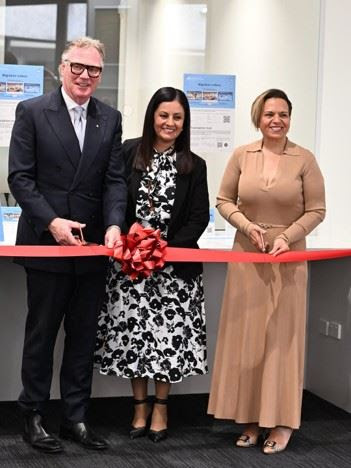
The opening of the new Migration Hub, located in the Federal Circuit and Family Court of Australia in Parramatta, marks the first time that dedicated court services have been provided for litigants involved in migration cases in Sydney’s western suburbs.
NSW Branch Committee Member Samar Nashi attended the opening of the Migration Hub on 22 May.
The hub provides:
- in-person filing facilities for migration cases
- facilities for Judicial Registrars to conduct in-person court events
- dedicated, purpose-built meeting spaces for Cultural Liaison Officers
- access to Migration Client Service Officers.
The event included a Welcome to Dharug Country by Aunty Thelma Rudd,
followed by speeches from:
- The Hon. Chief Justice William Alstergren AO
- The Hon. Michelle Rowland MP, Attorney-General of Australia
- Judicial Registrar Wajiha Ahmed, Director – Cultural Liaison Officer and Director – Cultural Language Diversity and Inclusion
- Kirsty Maylin, Director – Indigenous Policy and Operations.
The opening of the new Migration Hub is a significant step toward improving access to justice for court users in Western Sydney. The official opening was attended by the Commonwealth Attorney-General; the Hon. Michelle Rowland MP, Chief Justice of the Federal Circuit and Family Court of Australia; the Hon. William Alstergren AO; and representatives from local legal services, culturally and linguistically diverse (CALD) organisations and community service providers.
During the visit, the presenters explained the various resources and support services available to assist individuals and families. They also highlighted the important role interpreters and translators play in ensuring justice is achieved, particularly for people from CALD backgrounds, as effective communication is essential to fully understanding and participating in legal processes.
Their speeches highlighted the importance of improving access to court services and supporting people from diverse cultural backgrounds through more accessible and community-focused facilities.
Samar also had the opportunity to tour the facility and meet judges, lawyers, staff members and community representatives.
Developments in the global literary translation field
The 2024 Nobel Prize in Literature, awarded to Korean author Han Kang, has already sent ripples well beyond the literary mainstream. Inspired by the prize, a Korean-language interpreter self-funded the first-ever Lao translation of Han’s “Human Acts”, donating half the print run to schools in a country that shares, as he sees it, the novel’s preoccupation with surviving mass violence.
Meanwhile, Yang Shuang-zi’s “Taiwan Travelogue” — translated by Lin King — has become the first Mandarin-language work and first Taiwanese novel to win the International Booker Prize, with its jury singling out a book that is itself deeply concerned with the act of translation, set against the charged relationship between a Japanese writer and her Taiwanese translator under colonial occupation.
Yet even as literary translation gains this kind of cultural and institutional recognition, the profession as a whole is under serious strain: surveys across Europe show that most translators are already experiencing falling rates and fewer commissions, as AI tools hollow out the technical end of the market. Literary translators have so far proved more insulated, with publishers and authors resistant to ceding creative work to machines, and practitioners themselves insisting that dialogue, character, cultural nuance and wordplay remain beyond what AI can reliably handle. Taken together, these three developments sketch a field that is, at once, expanding its reach into new languages and communities, winning its highest honours, and fighting to define what human translation is for.
The rise of AI-powered translation across industries
AI-powered translation is reshaping communication across industries at a speed and scale that was unimaginable just a few years ago. Look out for my article on this topic in the upcoming (July) issue of In Touch magazine.
Thank you for your continued dedication to our profession and to the AUSIT community. I look forward to seeing many of you at our upcoming events, and as always, I encourage you to reach out. Your input and engagement are what make our association thrive.
With warmth and gratitude, |
Carl Gene Fordham National President Australian Institute of Interpreters & Translators (AUSIT) |

Supporting Professional Standards Visit our website Check our Professional Development page for upcoming PD events Read our award-winning quarterly magazine In Touch Find past newsletters and magazine articles on our blog This communication direct from AUSIT is part of your membership benefits. |
Copyright © 2024 AUSIT, all rights reserved |