


BOOK REVIEW
by Anthony Pym
reviewed by Dr Vera YZ Gu
‘At the heart of the book is the idea that risk arises when communication could fail …’
In his most recent book, renowned scholar Anthony Pym reframes translation – and, by extension, interpreting – not as a pursuit of linguistic fidelity, but as the art of managing communicative risk.
Published in the Cambridge University Press series Elements in Translation and Interpreting, the book offers a thought-provoking theoretical model that will resonate with practitioners and academics across the language services sector.
Although the focus is nominally on translation, Pym’s conceptual framework and examples consistently include interpreting scenarios. For AUSIT members – many of whom operate in time-pressured high-stakes environments such as healthcare, legal or community settings – the emphasis on uncertainty, cooperation and credibility strikes a familiar chord. However, from a practising interpreter’s perspective, the book’s compelling insights are not without tensions, particularly around ethics and professional boundaries.
At the heart of the book is the idea that risk arises when communication could fail – through either misunderstanding, misalignment of intent, or breakdown in cooperation. Interpreters and translators, according to Pym, are professionals not because they follow rules, but because they know when to bend them to preserve communicative purpose. This shift in framing has profound implications. It suggests that rigid adherence to word-for-word rendering may, at times, increase risk rather than reduce it.
To illustrate this, Pym examines case studies in which practitioners must act under constraints or uncertainty. One example is of a subtitler who works without access to video, relying only on a script and audio. Another focuses on community interpreting during the COVID-
19 pandemic, when trusted community leaders who were not formally trained interpreters were able to communicate essential health information quickly and effectively to culturally and linguistically diverse communities. In both cases, Pym argues that under pressure, cautious low-risk strategies – such as omitting ambiguous content and simplifying technical terms – can be both rational and ethically defensible.
This perspective is undeniably relevant to Australian interpreters, many of whom routinely experience imperfect working conditions and the need for on-the-spot decision-making; yet some of Pym’s examples are ethically fraught. He recounts how an Afghan interpreter working in a military setting intentionally modified a speaker’s message to appease American officers and protect himself. While understandable as a survival strategy and clearly an example of risk management, this action conflicts with professional codes of ethics, and Pym does not sufficiently interrogate the deeper ethical implications.
Similarly, he describes informal side conversations between interpreters and defendants in a Spanish courtroom. While positioned as pragmatic problem-solving, such behaviour would raise serious concerns in Australian legal contexts, where impartiality and transparency are paramount and the risk of compromising legal process or creating perceived bias cannot be overlooked.
Another theme that runs through the book is that of trust – not just in clients’ perception of interpreters, but also in the interpreter’s own judgement. Pym positions translators and interpreters as credibility-bearing agents whose role is to facilitate cooperation in the face of uncertainty. This is a powerful recognition of the relational dimension of our work. In courtrooms, hospitals, police stations and refugee interviews, trust is often the bedrock upon which effective communication is built. However, trust must be earned and exercised within clear ethical limits, something the book touches on but could address more directly.
Importantly, Risk Management in Translation does not idealise the profession. Pym is frank about institutional shortcomings – such as systemic underfunding, slow turnaround times, or the exclusion of interpreters from crisis planning (as in the COVID-19 response). He also highlights the irony that risk is often managed better by non-professionals than by professionals constrained by bureaucracy. While this may be true in some cases, it risks reinforcing a dangerous narrative: that informal communication is more effective than trained mediation. For interpreter advocates, this invites a response – calling not for less professionalism, but for more integrated, better-resourced, and community-informed language services.
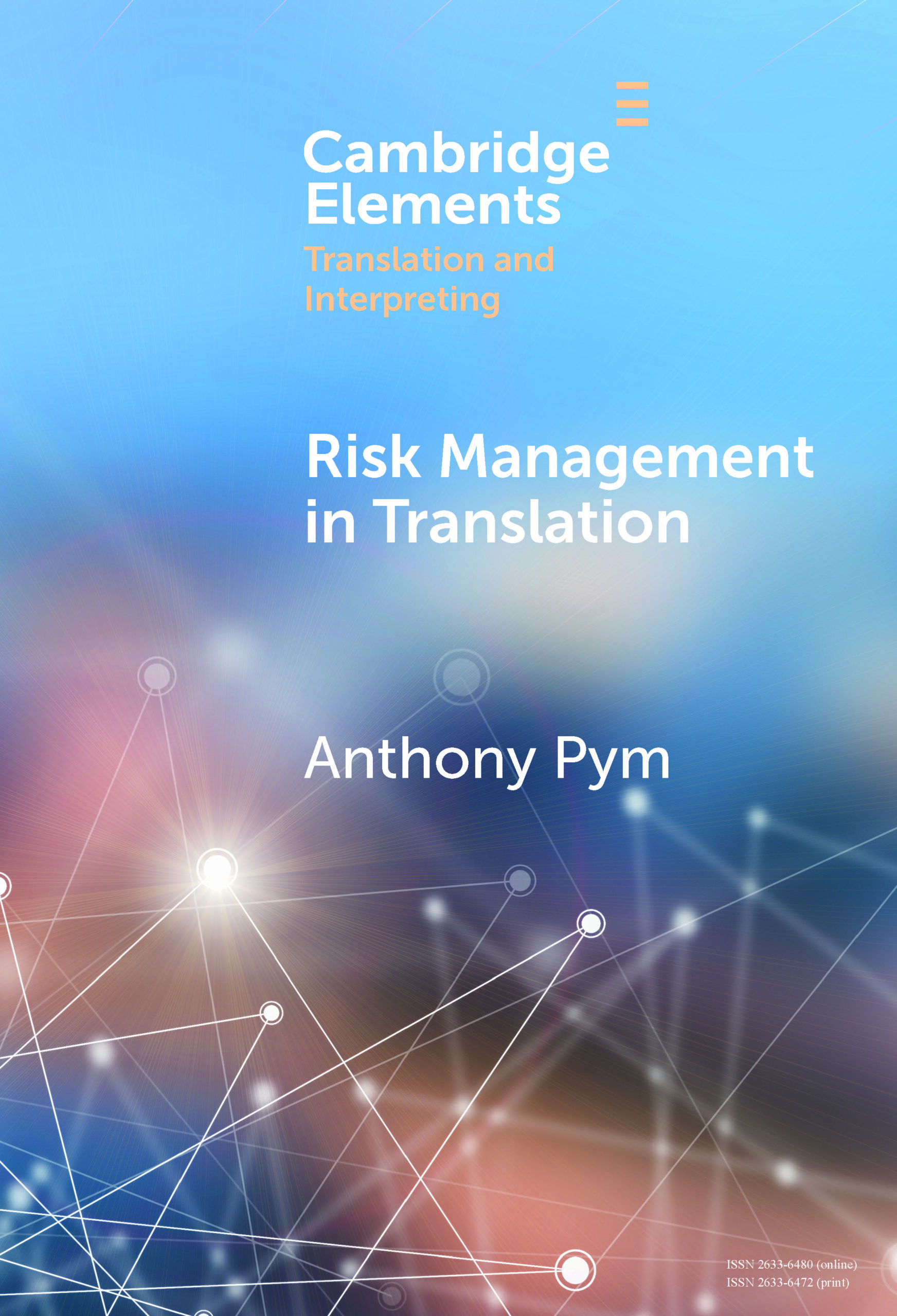
Cover reproduced courtesy of Prototype Publishing
Ultimately, the book excels in capturing the cognitive reality of interpreting: the rapid, high-stakes decision-making, the juggling of ethical and practical considerations, and the intuitive adjustments we make to maintain rapport, clarity and relevance. It offers a vocabulary that aligns with how many of us already think and work, even if unconsciously. However, it also raises an important caution: if risk management is left too vague or decoupled from professional standards, it can open the door to unaccountable or idiosyncratic practices.
For experienced interpreters this book provides a welcome opportunity to reflect on what we already know instinctively: that our job is not to reproduce words but to manage meaning, relationship and responsibility. For educators and trainees, it’s a valuable resource – but one that must be paired with careful guidance on ethical frameworks and institutional expectations. It’s not a how-to manual, but a conceptual map best read as a challenge to our professional assumptions and an invitation to reexamine how we define quality, success and professionalism in a risk-saturated world.

Dr Vera YZ Gu holds a PhD in applied linguistics, with a focus on T&I studies, from Monash University. Her research interests lie at the intersection of linguistics, T&I and cognition, with the aim of enhancing T&I pedagogy and practice. Alongside her academic pursuits, Vera is a professional translator and interpreter proficient in Chinese/Mandarin and English, with specialised training in conference interpreting.
Advertisement: