




RECENT RESEARCH
Researchers: Dr Laura Biggs, Rowena Coe and Professor Stephanie Brown, and the Working Together project team
Institution: Stronger Futures Centre of Research Excellence, Murdoch Children’s Research Institute, in collaboration with the Centre of Research Excellence in Stillbirth (Stillbirth CRE)
** TRIGGER WARNING: This research report contains content which may upset some readers **
Key terms
Perinatal: period of time during pregnancy and the following 12 months.
Perinatal loss: an overarching term inclusive of miscarriage, stillbirth and neonatal death.
Stillbirth: a baby is stillborn when they die prior to birth and after the 20th week of pregnancy (or, if the number of weeks is unknown, they weigh 400g or more*).
* If the week is unknown and they weigh under 400g, the loss is termed a miscarriage.
Australia is a very safe place to have a baby. Most women here experience good health during pregnancy, and most babies are born healthy and well – but sadly, this is not the case for all families.
Some communities of refugee and migrant background, and some Indigenous communities,* experience stillbirth more often than non-Indigenous Australian-born women and families. We don’t always know why a baby has died before birth, and it is not always possible to prevent. However, we do know that culturally safe trauma-responsive maternity care is critical to addressing preventable stillbirths. Interpreters are instrumental to this care.
The Working Together to Make Pregnancy Safer project is about health professionals, interpreters, and families that have refugee and migrant backgrounds* working in partnership to understand and support culturally safe approaches to stillbirth prevention in Australian pregnancy care. We have undertaken a series of interviews, discussion groups, surveys and co-design workshops with parents, interpreters and health professionals to produce:
• information about stillbirth prevention for parents receiving pregnancy care, and
• free online learning and resources for interpreters and health professionals.
* While this project worked specifically with refugee and migrant communities, the Stillbirth CRE is also working with Aboriginal and Torres Strait Islander communities to improve pregnancy care by creating tailored resources for both parents and clinicians.

What did we learn from parents, interpreters and health professionals?
• Women and families would like to have sensitive and honest conversations about stillbirth prevention during their pregnancy care.
• Conversations about stillbirth prevention can be easier and feel safer when women and families are able to get to know the health professionals and interpreters caring for them over time (continuity of caregivers and interpreters).
•It can be challenging for health professionals and interpreters to build trusting professional relationships in fragmented maternity care systems. However, both professional groups feel that strengthening their professional relationships could help to support high quality pregnancy care for women and families of refugee and migrant backgrounds.
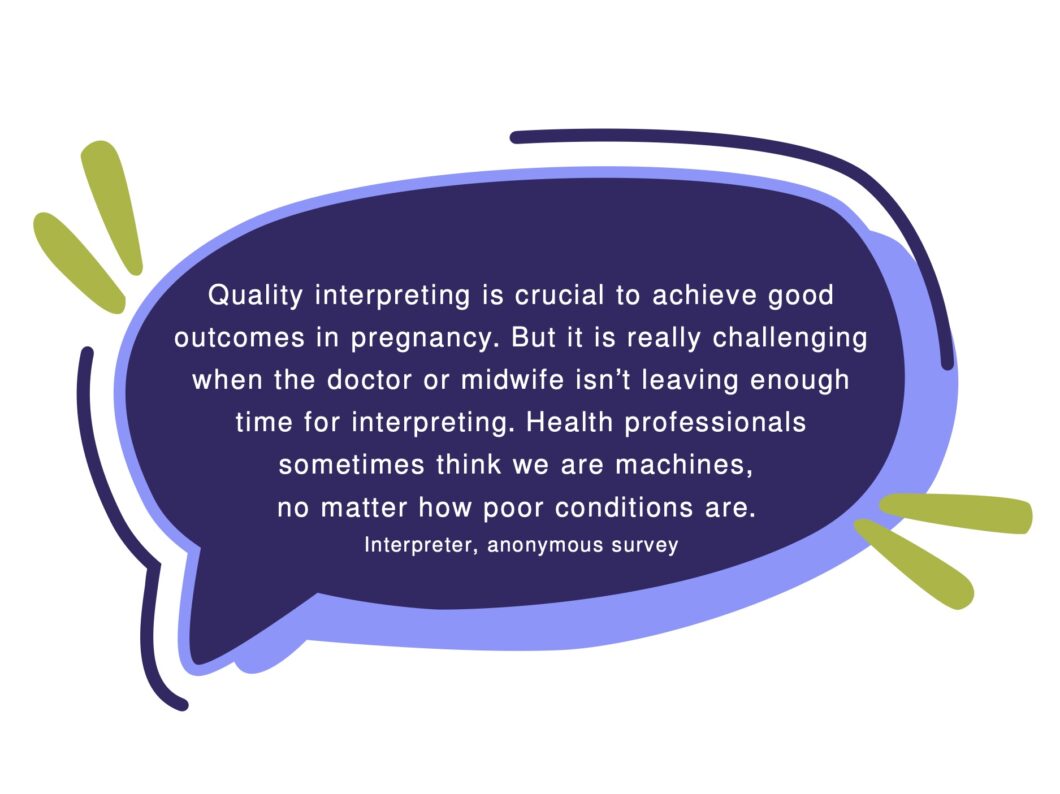
• Facilitating pregnancy care can be emotionally challenging for interpreters, especially when a family has an adverse experience such as perinatal loss.
What’s next?
We are sharing the results of our project at conferences, in journal articles and via professional associations.
We thank Leigh Cox of the Australian Department of Home Affairs for providing us with the raw data. All interpretations and opinions are our own.
The researchers’ statistical analysis and references can be found here.