For Students, Educators & Researchers
Thinking of studying translation and/or interpreting?
Why become a Student Member of AUSIT?
AUSIT Language Divisions
AUSIT Mentoring Program
AUSIT Student Excellence Awards (annual)
AUSIT Student Translation Competition (annual)
Resources and Grants for Researchers
AUSIT’s Educational Affiliates
Videos & Podcasts
For Practitioners
The Benefits of being a Member of AUSIT
Join AUSIT: Application Form
Guidelines and Resources for Practitioners
The AUSIT Code of Ethics
Professional Development
AUSIT Mentoring Program
Webinars
Free NAATI-Sponsored Webinars (conditions apply)
AUSIT Events
In Touch magazine
AUSIT Language Divisions
Blogs (including past President’s Newsletters)
Videos & Podcasts
AUSIT Awards and Fellowships
The Sydney Declaration (AUSIT National Conference Statement 2023)
Interpreter Feedback Form and Reports: experiences in courts and tribunals
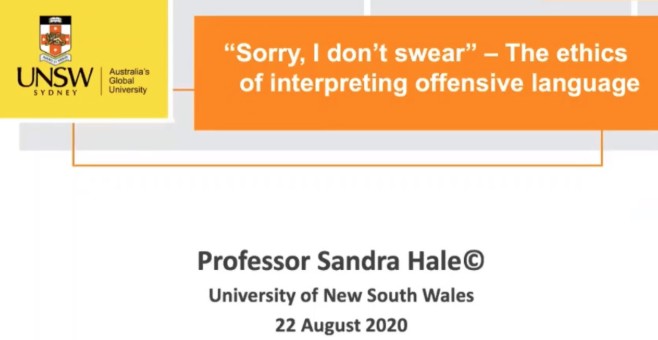
Duration:
1 Hr 15 mins
Presenter -
Prof Sandra Hale
$105.00 (Non-Member) | Free (Member) | $300.00 (Non-member Institution) | $150.00 (Affiliate)
Interpreters cannot control what the speakers will say and how they will express themselves in any interaction they are required to interpret. Particularly in high stakes legal settings, interpreters might be confronted with offensive or aggressive language from one or both speakers. These instances can possibly lead to ethical questions for some interpreters, such as: Should I tell the speaker not to use vulgar language? Should I tone it down? Should I report that the speaker just swore? Should I just omit the vulgar language and interpret the substance of the utterance? Or should I interpret the swearing? Some interpreters have argued that it is not necessary to interpret the swearing because it doesn’t affect the core message. Others have argued that their moral values or beliefs prevent them from interpreting vulgar language. The question, however, should be: What is ethical for an interpreter to do in such situations? This presentation will discuss different scenarios and their potential consequences in light of the AUSIT Code of Ethics and other standards and requirements, making reference to results of recent research.
Presenter:
Professor Sandra Hale was AUSIT National President from 2014-2017 and is currently convenor of the I&T programs at UNSW. Her qualifications include a BA in I&T, Dip.Ed., Master of Applied Linguistics, and PhD in court interpreting/forensic linguistics. She has been awarded a Doctorate Honoris Causa by the University of Antwerp for her ground-breaking research into Community Interpreting.
Anna Kenny is a Polish Interpreter and a Professional Development Coordinator with NSW Health Care Interpreter Services. She holds a Master’s degree in Interpreting and Translation Pedagogy from Macquarie University. Anna has worked for HCIS for over 25 years. In her current position, she coordinates and facilitates training for health care interpreters across NSW. She has also taught interpreting at Macquarie University and developed medical interpreting resources for RMIT.
Other webinars you might be interested in
for court interpreters to report incidents or issues that occur in court interpreting assignments.
Purpose and function of this information submission form.
This form enables you to report issues or problems that you encounter in the course of court interpreting assignments. These issues and problems will be collected by AUSIT to report to the JCCD (the Judicial Council on Cultural Diversity) to monitor the implementation of the Recommended National Standards. The reporting of these issues and problems enables AUSIT to work with the JCCD to suggest steps to address these issues and to avoid the repetition of these problems in the future.
"*" indicates required fields
Select your desired option below to share a direct link to this page