
Navi Logo 2.png
Navi Close.svg
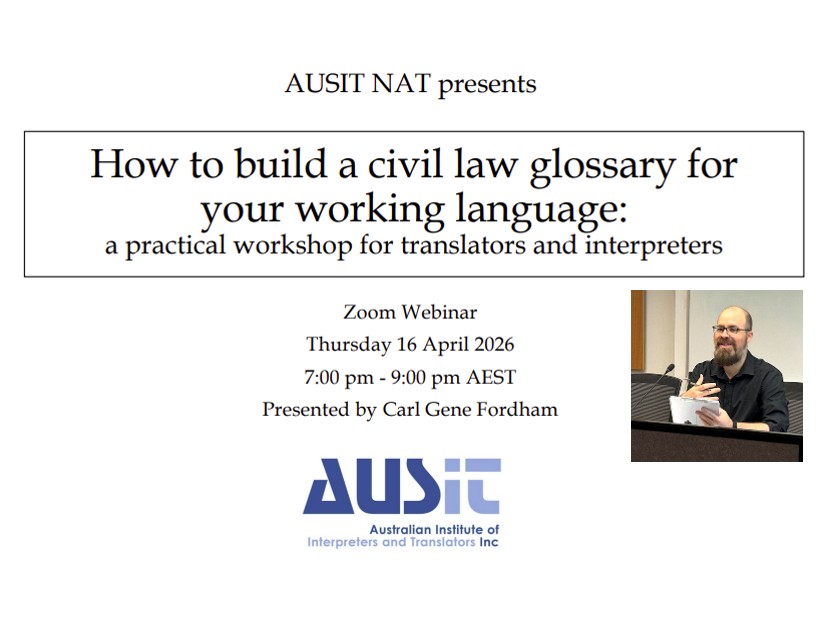
20260416 Civil Law Gloassary Thumbnail

AUSIT Webinar | 20260416 How to build a Civil Law Glossary for your working language

Thursday, April 16, 2026

Duration:

1h 51m

Presenter -

Dr Chelsea Larkman

$105.00 (Non-Member) | $35.00 (Member) | $300.00 (Non-member Institution) | $150.00 (Affiliate)

Description

Civil law assignments are widespread, spanning courts and tribunals at every jurisdiction. There is also a growing private client market where non-English-peaking parties in commercial litigation and family law matters seek out and pay for their own translators and interpreters. Yet many colleagues still shy away from this work. Not because they lack skill, but because the terminology is unfamiliar, and the Australian legal system may differ greatly from the systems they know.

This workshop is designed to change that. Rather than working through legal terms from A to Z, you will learn how to organise Australian civil law concepts into categories, building a bigger-picture understanding of the legal system that is far more useful in practice. By the end of the session, you will have a structured foundation and all the tools you need to construct a comprehensive glossary in your working language, ready to support non-English-speaking litigants as they give instructions to their lawyers, participate in mediation, and appear before courts and tribunals.

The workshop covers the key areas of civil law that translators and interpreters commonly work in, such as contracts, torts, immigration, family law, property law, and wills and estates. It also walks through civil procedure from the commencement of proceedings through to judgment, with a focus on the role translators and interpreters play at each stage. Together, these two components give participants both the substantive knowledge and the procedural understanding they need to work effectively in civil law settings.

This workshop is ideal for both translators and interpreters seeking greater confidence in civil court and tribunal assignments. It is also well suited to those looking to attract private clients: parties in civil law matters who engage their own translator or interpreter, whether self-represented or legally assisted.

By participating in this PD event, you will receive:

  • A civil law glossary template to create your own glossary in your working language;
  • A list of the best free resources to help you understand Australian civil law and translate it accurately;
  • Access to the webinar recording so you can catch up on any important points you may have missed;
  • Increased confidence to translate and interpret for civil matters in Australian courts and tribunals.


Our Presenter – Carl Gene Fordham

Carl Gene Fordham is a NAATI-Certified interpreter and translator who specialises in court interpreting and forensic translation. He also teaches translation and interpreting at the University of Queensland and serves as the current National President of AUSIT. Carl’s working languages are Chinese/Mandarin and English.

Other webinars you might be interested in

Submission form

for court interpreters to report incidents or issues that occur in court interpreting assignments.

Purpose and function of this information submission form.

This form enables you to report issues or problems that you encounter in the course of court interpreting assignments. These issues and problems will be collected by AUSIT to report to the JCCD (the Judicial Council on Cultural Diversity) to monitor the implementation of the Recommended National Standards. The reporting of these issues and problems enables AUSIT to work with the JCCD to suggest steps to address these issues and to avoid the repetition of these problems in the future.

Share This

Select your desired option below to share a direct link to this page