For Students, Educators & Researchers
Thinking of studying translation and/or interpreting?
Why become a Student Member of AUSIT?
AUSIT Language Divisions
AUSIT Mentoring Program
AUSIT Student Excellence Awards (annual)
AUSIT Student Translation Competition (annual)
Resources and Grants for Researchers
AUSIT’s Educational Affiliates
Videos & Podcasts
For Practitioners
The Benefits of being a Member of AUSIT
Join AUSIT: Application Form
Guidelines and Resources for Practitioners
The AUSIT Code of Ethics
Professional Development
AUSIT Mentoring Program
Webinars
Free NAATI-Sponsored Webinars (conditions apply)
AUSIT Events
In Touch magazine
AUSIT Language Divisions
Blogs (including past President’s Newsletters)
Videos & Podcasts
AUSIT Awards and Fellowships
The Sydney Declaration (AUSIT National Conference Statement 2023)
Interpreter Feedback Form and Reports: experiences in courts and tribunals
Duration:
1h 50m
Presenter -
Michael Broughton
$105.00 (Non-Member) | $35.00 (Member) | $300.00 (Non-member Institution) | $150.00 (Affiliate)
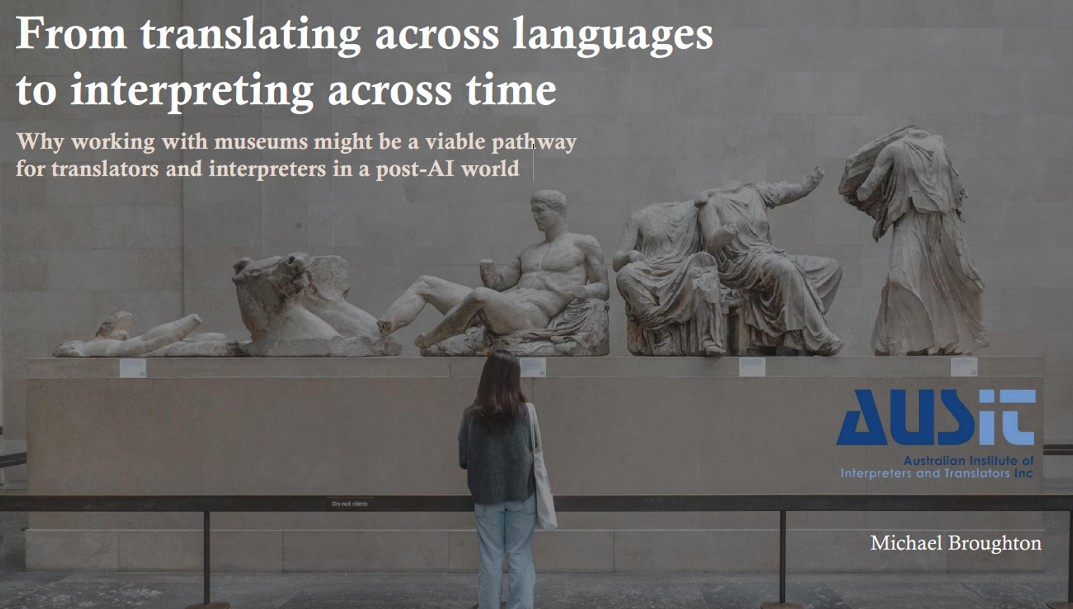
In this webinar, we look at one possible pathway for translators and interpreters to turn towards in a post-AI world—working with museums. Museums, galleries and heritage sites are institutions that play an important role in defining who we are and constructing the nation we live in. They are also, fundamentally, institutions engaged in interpreting. They translate the past for modern audiences and help us to understand what our heritage means. This makes museums a field that we can turn to as we look to use our skills and knowledge in industries outside of straight translation and interpreting. And this doesn’t just mean translating exhibits and interpreting tours. Museums are spaces where we can creatively apply our skills not just to translate across languages, but to interpret across time. If we can make this conceptual shift, if we can realise that the past is another country, a country that needs its own interpreters and translators, we may find that the future of human translation lies, in part, in interpreting our past. Key Takeaways:
– Understand what “interpreting” means in a museum context
– Explore the common challenges when translating across time
– Widen your perspective beyond language
Other webinars you might be interested in
for court interpreters to report incidents or issues that occur in court interpreting assignments.
Purpose and function of this information submission form.
This form enables you to report issues or problems that you encounter in the course of court interpreting assignments. These issues and problems will be collected by AUSIT to report to the JCCD (the Judicial Council on Cultural Diversity) to monitor the implementation of the Recommended National Standards. The reporting of these issues and problems enables AUSIT to work with the JCCD to suggest steps to address these issues and to avoid the repetition of these problems in the future.
"*" indicates required fields
Select your desired option below to share a direct link to this page