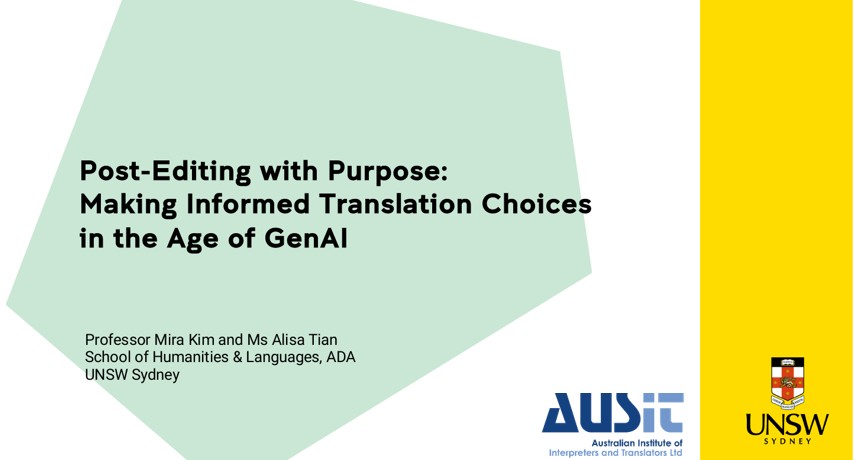
As generative AI and machine translation become part of everyday professional practice, post-editing increasingly involves evaluating and refining translation choices, rather than simply correcting errors. This professional development workshop supports translators and interpreters in developing a clear, principled approach to post-editing that strengthens professional judgement and efficiency.
The workshop introduces a meaning-focused framework for analysing AI-generated translations, helping participants identify where and why key translation choices need to be made. Participants will work with practical examples to examine choices related to:
- what is being represented (accuracy, completeness, and logic of meaning);
- how meaning positions the reader or listener (voice, stance, evaluation, and interpersonal alignment); and
- how meaning is organised as a text (flow, cohesion, emphasis, and readability).
Through guided activities, participants will learn how to diagnose recurring machine-translation patterns, prioritise revisions strategically, and articulate the rationale behind their post-editing decisions—skills that are increasingly important for quality assurance, ethical practice, and client communication.
This practical framework is richly informed by Systemic Functional Linguistics (SFL), which has long served translation studies as a powerful tool for analysing meaning in context. However, no prior knowledge of SFL is assumed; the theory is introduced as a way of naming and strengthening what practitioners already do intuitively.
The workshop positions post-editing as skilled interpretive work, reaffirming the translator’s and interpreter’s role as active meaning-makers, rather than passive correctors of machine output.
Our Presenters
Professor Mira Kim is a researcher, educator, and practitioner in the field of translation and interpreting. She has worked as a professional translator and interpreter since 1995 and has been teaching both practical and theoretical courses since 2000. Her research areas include text analysis for translation, translation quality assessment, translator education, systemic functional linguistics, and personalised language learning. She is the lead author of Korean Grammar: A Systemic Functional Perspective (Cambridge University Press, 2023) and co-editor of Systemic Functional Linguistics and Translation Studies (Bloomsbury, 2021). She is currently a Professor at UNSW Sydney.
Alisa Tian is an Associate Lecturer in Translation and Interpreting at UNSW Sydney, with extensive experience in professional translation and interpreting practice. Having worked as an in-use legal translator/interpreter at a publicly listed international law firm, she continued as a freelance practitioner across Australia and overseas, including as a subtitler at SBS Australia, where she currently quality-checks AI-generated translations for television programs. Since 2010, Alisa has been teaching postgraduate T&I programs, with a strong interest in theory-informed translation pedagogy, particularly Systemic Functional Linguistics.