Navi Logo 2.png
Navi Close.svg
Using Llms For Formative Feedback Thumbnail

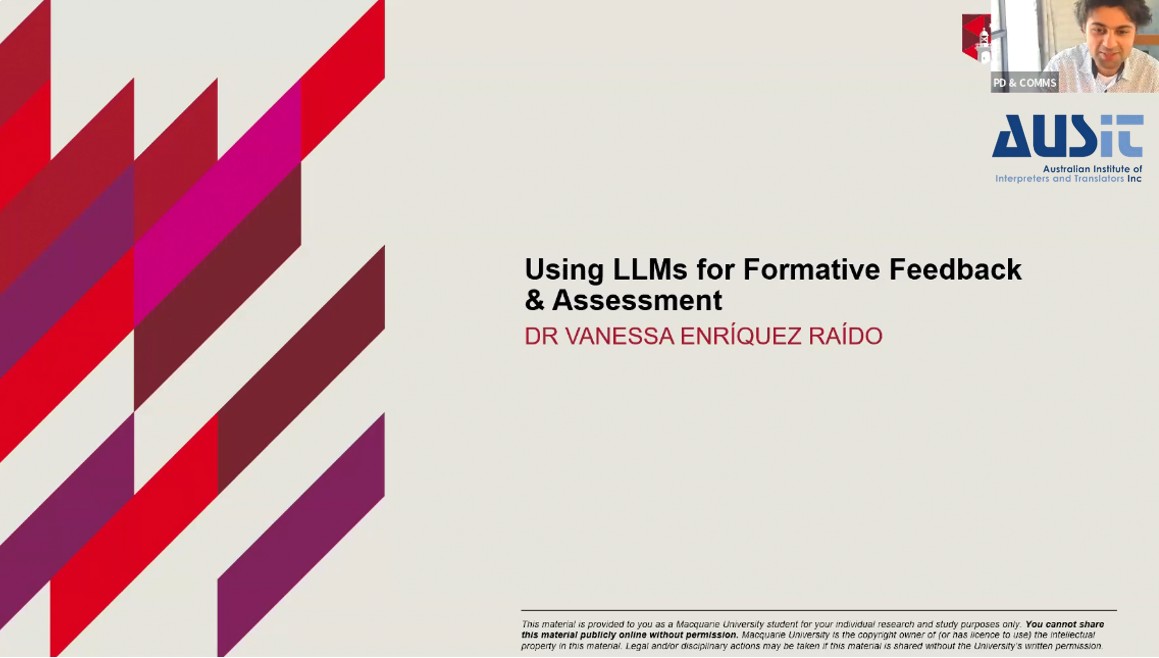
AUSIT Webinar | 20251217 Using LLMs for Formative Feedback in Translator Training

Wednesday, December 17, 2025

Duration:

1h 50m

Presenter -

Dr Vanessa Enríquez Raído

$105.00 (Non-Member) | $35.00 (Member) | $300.00 (Non-member Institution) | $150.00 (Affiliate)

Description

Many educators wonder how to integrate LLMs into translation pedagogy without undermining learning outcomes or academic integrity. This hands-on webinar presents a process-oriented methodology that positions LLMs as formative-feedback partners rather than output generators.

Part 1: Prompting Foundations for Translation Pedagogy

Explore prompt design for translation contexts:

  • Understanding core prompt types and structural elements
  • Encoding translation-brief components (purpose, audience, register, domain constraints)
  • Injecting terminology and style guidance
  • Applying reliability tactics for classroom use: task decomposition, source-citation prompts, and rubric-based evaluation frameworks
  • Iterating prompts and reframing ‘failure’ and ‘uncertainty’ as pedagogical opportunity

Part 2: Process-Oriented Assessment Framework

We address a key challenge: How do we assess student engagement with LLMs in ways that develop evaluative judgment and anticipatory reasoning, rather than dependency?

This section demonstrates a practical setup that decouples process from product:

  • Students submit process artefacts (AI interaction logs, prompt iterations, revision plans, reflection notes) that reveal their reasoning and judgement abilities
  • LLMs are confined to specific roles: critique partner, planning support, cognitive scaffold—not solution provider
  • Formative cycles credit the learning process independently of outcome quality

What You’ll Leave With:

  • Prompt examples for common translation-pedagogy scenarios
  • A process-artefact framework for AI-enabled formative feedback
  • Step-by-step integration checklist for your courses
  • Strategies for making AI engagement transparent and pedagogically sound

Target Audience:

Educators and course designers in translator and interpreter training; unit conveners, tutors, and learning designers; translators and interpreters interested in becoming educators or trainers.

Our Presenter – Vanessa Enríquez Raído

Vanessa is a Senior Lecturer in Translation Technologies in the Department of Linguistics at Macquarie University, Sydney. With a professional background in technical translation and software localisation, she teaches human-machine translation and has delivered translation technology workshops internationally. Her research focuses on translator education, translation-centred information seeking, and developing translators’ AI literacy to critically engage with translation and large language models in professional practice. She has received awards for excellence in teaching and research at the University of Auckland.

Other webinars you might be interested in

Submission form

for court interpreters to report incidents or issues that occur in court interpreting assignments.

Purpose and function of this information submission form.

This form enables you to report issues or problems that you encounter in the course of court interpreting assignments. These issues and problems will be collected by AUSIT to report to the JCCD (the Judicial Council on Cultural Diversity) to monitor the implementation of the Recommended National Standards. The reporting of these issues and problems enables AUSIT to work with the JCCD to suggest steps to address these issues and to avoid the repetition of these problems in the future.

Share This

Select your desired option below to share a direct link to this page