For Students, Educators & Researchers
Thinking of studying translation and/or interpreting?
Why become a Student Member of AUSIT?
AUSIT Language Divisions
AUSIT Engage (community engagement hub)
AUSIT Mentoring Program
AUSIT Student Excellence Awards (annual)
AUSIT Student Translation Competition (annual)
Resources and Grants for Researchers
AUSIT’s Educational Affiliates
Videos & Podcasts
For Practitioners
The Benefits of being a Member of AUSIT
Join AUSIT: Application Form
AUSIT Engage (community engagement hub)
Guidelines and Resources for Practitioners
The AUSIT Code of Ethics
Professional Development
AUSIT Mentoring Program
Webinars
Free NAATI-Sponsored Webinars (conditions apply)
AUSIT Events
In Touch magazine
AUSIT Language Divisions
Blogs (including past President’s Newsletters)
Videos & Podcasts
AUSIT Awards and Fellowships
The Sydney Declaration (AUSIT National Conference Statement 2023)
Interpreter Feedback Form and Reports: experiences in courts and tribunals
Duration:
1h 48m
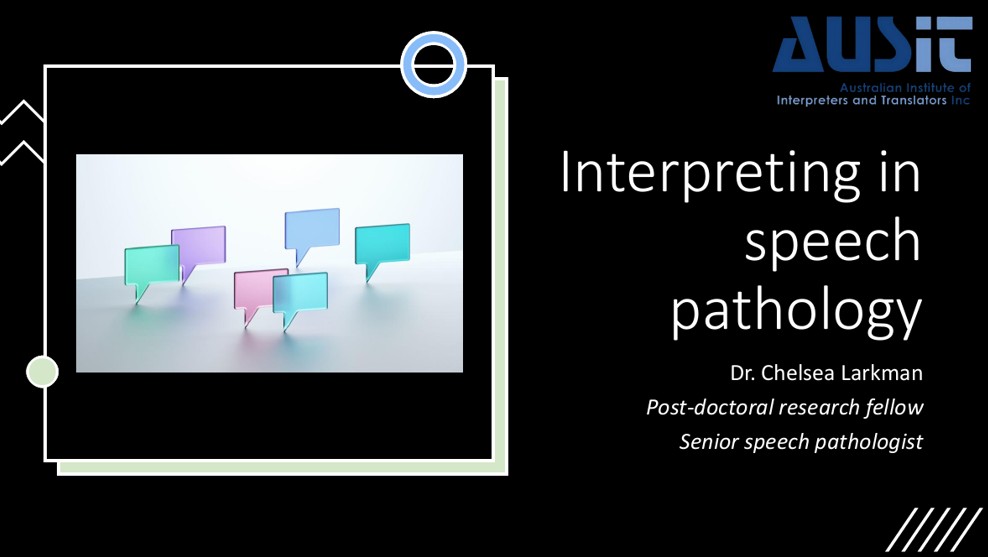
Presenter -
Dr Chelsea Larkman
$105.00 (Non-Member) | $35.00 (Member) | $300.00 (Non-member Institution) | $150.00 (Affiliate)
Interpreting in speech pathology and acquired communication disorders is a complex area of specialised practice. It requires interpreters to not only facilitate communication between the speech pathologist and client but also provide the speech pathologist with a description of how the client is communicating and render into English disordered speech or language. However, most interpreters do not receive training and preparation on how to work with speech pathologists or clients with communication difficulties.
In this webinar, we will discuss:
– What makes speech pathology a complex area of practice and the challenges reported by both interpreters and speech pathologists
– Opinion vs description: The importance of providing a description of communication and working within your scope of practice
– Acquired communication disorders (definitions, typical features, examples)
– Models and tools for collaboration between speech pathologists and interpreters
– Common communication assessment tools
– Collaborating with speech pathologists for therapy
Our Presenter – Dr Chelsea Larkman
Dr Chelsea Larkman is a senior speech pathologist and early career researcher with extensive clinical experience working with adults with communication and swallowing difficulties across hospital and community settings. Chelsea recently completed her PhD investigating cultural and linguistic adaptation of aphasia rehabilitation.
Chelsea’s frequent collaborations with professional interpreters whilst working with clients from different language backgrounds motivated her to undertake this research. She explored the challenges of aphasia therapy when the speech pathologist and client do not share a language and used co-design involving speech pathologists and interpreters to identify possible solutions to these challenges. One potential solution developed through this co-design work is the La Trobe University Aphasia therapy Collaboration Tool for Speech Pathologists and Interpreters (LTU ACT-SPI).
Other webinars you might be interested in
for court interpreters to report incidents or issues that occur in court interpreting assignments.
Purpose and function of this information submission form.
This form enables you to report issues or problems that you encounter in the course of court interpreting assignments. These issues and problems will be collected by AUSIT to report to the JCCD (the Judicial Council on Cultural Diversity) to monitor the implementation of the Recommended National Standards. The reporting of these issues and problems enables AUSIT to work with the JCCD to suggest steps to address these issues and to avoid the repetition of these problems in the future.
"*" indicates required fields
Select your desired option below to share a direct link to this page